
| Quick Summary: Google released the March 2026 Core Update after the spam update completed on March 25, 2026. This is the first core update of the year. Focus on E-E-A-T, helpful content, Core Web Vitals, and information gain to maintain or recover your rankings. The rollout may take up to two weeks to fully complete. |
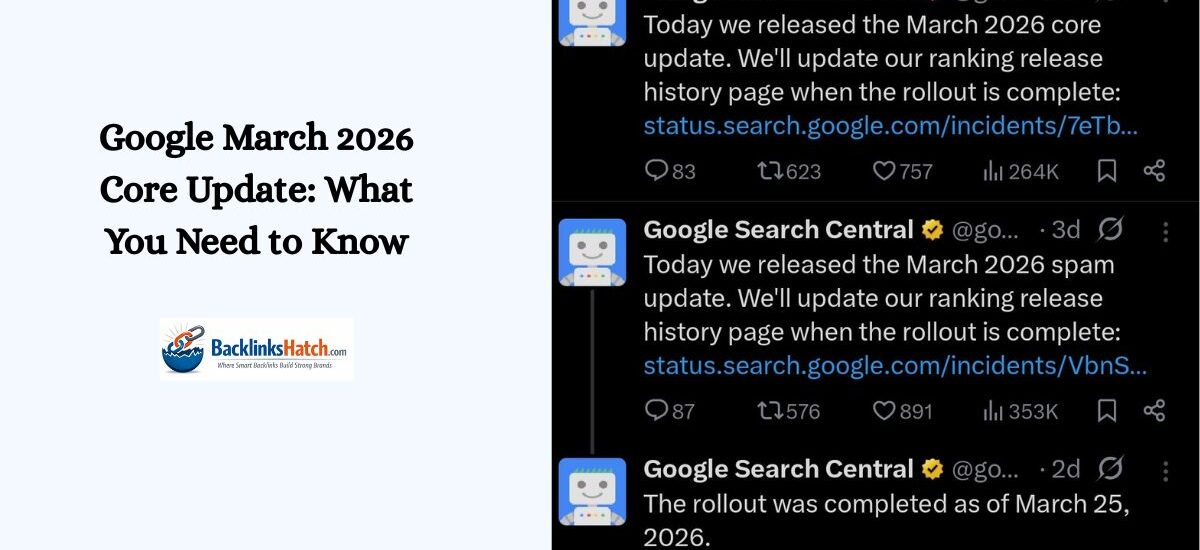
If your website rankings have been moving up or down recently, the Google March 2026 Core Update is most likely the reason. Google officially announced this update through its Search Central account, confirming the rollout began after the March 2026 spam update, which itself completed on March 25, 2026. This makes the core update the second major algorithm event in just a matter of days, and website owners across every niche are feeling the effects.
In this guide, we break down exactly what this update is, what Google is targeting, who it affects, and — most importantly — what you should do next.
Table of Contents
What Is the Google March 2026 Core Update?
A core update is Google’s way of making significant, broad changes to how its search algorithm ranks content across the entire web. It is not targeted at one type of website or one specific bad behavior. Instead, it re-evaluates how relevant, helpful, and trustworthy all content is — and reshuffles rankings accordingly.
Google Search Central officially announced: “Today, we released the March 2026 core update. We’ll update our ranking release history page when the rollout is complete.” This came shortly after the spam update completed on March 25, 2026 — meaning site owners had barely recovered from one algorithm event before another began. The rollout is expected to take up to two weeks to fully complete.
How Core Updates Differ from Spam Updates
Many people confuse core updates with spam updates, but they serve very different purposes. The March 2026 spam update that completed on March 25 was specifically designed to catch websites violating Google’s spam policies — things like keyword stuffing, cloaking, manipulative link schemes, and low-quality auto-generated pages created purely to manipulate rankings.
The Google March 2026 Core Update, on the other hand, is not a penalty system. It doesn’t look for rule-breakers. Instead, it looks at every page on the web and asks a simple question: Does this content genuinely satisfy what the user was searching for? If the answer is yes, rankings improve. If not, they drop — even if the website has done nothing technically wrong.
This distinction matters because the recovery strategy for each is completely different. Spam recovery means fixing policy violations. Core update recovery means improving content quality, depth, and trustworthiness.
Why Two Major Updates in the Same Week?
The back-to-back timing of the spam update and core update is not a coincidence. Google has increasingly bundled major algorithm changes into concentrated rollout windows. The spam update clears out the most obvious low-quality content first, and then the core update re-evaluates what remains with a finer lens. Together, they represent Google’s most thorough assessment of content quality the web has seen in 2026 so far.
For website owners and SEO professionals, this means the impact of both updates combined could be more significant than either one alone. Sites that survived the spam update may still see ranking changes from the core update — and the two weeks of rollout mean the full picture won’t be clear until mid-April 2026.
Google March 2026 Core Update: Key Ranking Signals That Changed
Understanding what this update rewards is the most practical thing you can do right now. Based on Google’s own public guidance and consistent patterns across previous core updates, here are the signals that matter most.
Content That Actually Helps Real People
Google’s core evaluation has always centered on one fundamental question: was the person who searched for this satisfied after reading your page? The Google March 2026 Core Update strengthens this evaluation by looking more carefully at whether your content provides a complete, accurate, and genuinely useful answer — or whether it just appears to be on the surface.
Content that tends to rank well after core updates consistently shares these characteristics:
- It answers the question fully without forcing the reader to go elsewhere for the rest of the answer
- It is written from a place of genuine subject matter expertise or first-hand experience
- It anticipates follow-up questions and addresses them within the same page
- It is organized clearly so the reader can find what they need quickly
- It does not pad word count with filler sentences that add no real value
Thin content — meaning pages that touch on a topic without truly covering it — is the biggest loser in almost every core update. If your pages exist primarily to target a keyword rather than to genuinely inform a reader, the March 2026 core update will likely move them down in rankings.
E-E-A-T: Experience, Expertise, Authoritativeness, and Trustworthiness
E-E-A-T remains the central framework Google uses to evaluate content quality, and this update reinforces it further. Google’s human quality raters use E-E-A-T as their primary lens when assessing whether pages deserve to rank, and the algorithm increasingly reflects those same judgments.
Here is what each element means in practical terms for your website:
- Experience means the content shows the author has actually done, used, or lived through what they are writing about — not just researched it
- Expertise means the content demonstrates a high level of knowledge and understanding of the topic
- Authoritativeness means your website and its authors are recognized as credible voices in your niche by other credible sources
- Trustworthiness means your site is transparent, accurate, secure, and does not mislead readers in any way
Sites that are losing rankings after this update often have strong-looking content on the surface but fall short on one or more of these dimensions — particularly experience and trustworthiness. Adding detailed author bios, citing credible sources, and making your editorial standards visible to readers are among the highest-impact improvements you can make right now.
Technical Performance Still Plays a Role
Content quality is the biggest factor in any core update, but technical SEO is not irrelevant. Google has been consistently clear that a slow, poorly structured website creates a worse user experience — and user experience feeds directly into how Google evaluates page quality.
Core Web Vitals and Page Speed
Core Web Vitals are Google’s standardized measurements of real-world user experience on your pages. They cover loading speed, visual stability, and responsiveness. After the March 2026 core update, pages that score poorly on these metrics are at a disadvantage — especially in competitive niches where multiple pages offer similar content quality.
| Core Web Vital | What It Measures | Good Score |
| LCP (Largest Contentful Paint) | How fast does the main content load | Under 2.5 seconds |
| INP (Interaction to Next Paint) | How fast does the page respond to clicks | Under 200ms |
| How fast does the main content load | Visual stability as the page loads | Under 0.1 |
| TTFB (Time to First Byte) | How fast the main content load | Under 800ms |
If your content quality is strong but your technical scores are weak, fixing Core Web Vitals can be the difference between ranking on page one and sitting on page two. Use Google PageSpeed Insights to identify and fix your specific issues.
Site Structure and Crawlability
Beyond raw speed, Google needs to be able to crawl and understand your site efficiently. A clean site structure with logical internal linking helps Google discover your most important pages and understand how your content relates to each other. After this update, sites with poor internal linking or confusing architecture may find that their best content is not getting the visibility it deserves.
Make sure your site has:
- Most important pages are reachable within a few clicks from the homepage
- Internal linking that connects related content meaningfully and contextually
- No orphaned pages sitting with zero internal links pointing to them
- An up-to-date XML sitemap submitted to Google Search Console
- Proper schema markup and structured data to help Google understand your content type and context
A technically clean site amplifies the impact of great content. A technically broken site buries it — even when the content itself is excellent.
Who Is Most Affected by This Update?
The Google March 2026 Core Update affects every type of website, but certain categories consistently see the most movement after broad core updates.
High-Risk Content Categories: YMYL Sites
Websites in YMYL niches — Your Money or Your Life — face the toughest evaluation after every core update. These are topics where inaccurate information could directly harm a reader’s health, finances, safety, or well-being. Categories include:
- Health and medical information websites
- Personal finance, investing, and insurance content
- Legal advice and information pages
- News, current events, and civic information publishers
Google holds these categories to a higher E-E-A-T standard because the consequences of inaccurate information are more serious for real people. If you operate in any of these niches without strong author credentials, clear sourcing, and transparent editorial standards, this update may have already impacted your organic search visibility.
The fix is not superficial. Adding a generic author bio or citing one source is not enough. You need to demonstrate genuine, verifiable expertise at every level — the author, the content itself, and the overall reputation of your website.
Content-Heavy Blogs and Affiliate Sites
Blogs and affiliate marketing websites that publish large volumes of product reviews, comparison articles, or informational content are also commonly affected by core updates. The key vulnerability here is thin or duplicative content — pages that cover the same ground as hundreds of other sites without offering anything unique.
If your affiliate site lost rankings, the honest question to ask is: Does my review or article add anything that a reader could not find from the top five results that already rank? Does it include real first-hand testing, original photography, unique data, or a perspective no one else offers? If not, that is your answer and your roadmap.
Sites that publish content at high volume using templates or AI-generated drafts without proper editorial oversight are particularly at risk. The update strengthens Google’s ability to identify content that reads fluently but contributes nothing genuinely new to the conversation.
How to Respond to the Google March 2026 Core Update
There is no shortcut or technical trick that reverses a core update impact. Google is explicit about this. But there is a clear, logical process that works — it just takes time and genuine effort.
Step One: Diagnose Before You Change Anything
Before changing anything on your website, spend time understanding exactly what happened. Open Google Search Console and look at your performance data around March 25–27, 2026. Identify which pages lost the most impressions and clicks, which search queries dropped in average position, and whether the drop was site-wide or concentrated in specific sections or content categories.
This diagnosis tells you where to focus your improvement effort. Changing things randomly without understanding the pattern is the most common mistake site owners make after a core update. A targeted, evidence-based approach will always outperform a panicked, scattershot response.
Also check: did competitors gain ground on the same queries you lost? If so, compare your content honestly against theirs. What are they doing that you are not? That comparison is often the most direct path to understanding what Google is now rewarding in your specific niche after the March 2026 core update.
Step Two: Improve Content Depth and Trustworthiness
For every page that lost rankings, apply this honest evaluation framework drawn directly from Google’s own content quality guidelines:
- Does this page fully answer what someone searching this topic actually needs — or does it leave gaps?
- Does the author have genuine expertise or first-hand experience with this subject?
- Is there anything on this page that a reader could not find anywhere else?
- Would a knowledgeable friend in this field consider this page trustworthy and accurate?
- Is the page easy to read, well-organized, and free of unnecessary filler?
The difference between a real content improvement and a superficial tweak is depth. Adding a few sentences or changing some headings is not what recovers rankings after a core update. What works is genuinely making the page more helpful — adding original insights, filling gaps the current version leaves open, strengthening author credentials, and restructuring content so it is easier to use.
Frequently Asked Questions
Has the March 2026 core update finished rolling out?
The spam update that preceded it completed on March 25, 2026, according to Google Search Central. The core update began rolling out shortly after. Google confirmed the rollout may take up to two weeks, so full stabilization is expected by around mid-April 2026.
My rankings dropped — what should I do?
Start with diagnosis, not immediate changes. Open Google Search Console, identify which pages dropped and on which queries, and wait until the rollout is complete before drawing firm conclusions. Rankings often continue shifting during the two-week rollout window. Then make meaningful, substantive improvements based on your findings.
Does this update penalize AI-generated content?
Not directly. Google’s stated position is that the quality of content matters, not how it was produced. Helpful, accurate, well-edited content is fine regardless of whether AI writing tools were involved. What gets penalized is low-quality, mass-produced content with no editorial value — whether written by AI or humans.
Which industries were most affected?
Healthcare, finance, legal, and e-commerce sites with YMYL content saw the biggest shifts, since E-E-A-T requirements are highest in these verticals. Affiliate blogs and content-heavy informational sites also experienced significant volatility.
How long does recovery take after a core update?
There is no fixed recovery timeline. Some sites recover partially before the next core update through continued improvements. Meaningful, lasting recovery most reliably comes after a subsequent core update once Google re-crawls and re-evaluates your improved content.
Conclusion
The Google March 2026 Core Update is a clear signal that Google is doubling down on what it has always said matters: original, helpful, trustworthy content backed by real expertise and solid technical foundations. Sites winning after this update are not doing anything secret — they are publishing content that genuinely helps people, demonstrating real authority, and keeping their websites technically healthy.
If your site was affected, treat it as feedback, not a catastrophe. Audit your content honestly, invest in E-E-A-T signals, add genuine information gain to your most important pages, and fix your Core Web Vitals. The path forward is clear — and the sites that take it seriously now will be the ones that benefit most when the next update arrives.
Google has always rewarded the same thing: real value for real people. The Google March 2026 Core Update has not changed that. It has simply made Google better at recognizing it.