Link building remains one of the most powerful ranking factors in SEO. But not all links are created equal, and not all methods of earning them are safe. Understanding white hat vs black hat link building is not optional in 2026. It is the difference between sustainable organic growth and a Google penalty that wipes out years of work overnight. Before you invest a single dollar into any link building campaign, you need to know exactly which side of the line you are standing on.
1. What Is Link Building and Why It Still Matters in 2026
Backlinks are votes of confidence from one website to another. Google treats them as a signal of authority, relevance, and trust. The more high-quality backlinks your site earns, the stronger its position in search results.
In 2026, Google’s algorithms are smarter than ever. AI-driven link quality assessments, spam detection models, and manual review teams all work together to evaluate your link profile. The volume of links matters far less than it did five years ago. What matters now is the quality, relevance, and editorial nature of each link.
According to Google’s Search Quality Evaluator Guidelines, page quality is directly tied to the trustworthiness and authority of the sources linking to a page. This is the foundation of every legitimate link-building strategy. You can read more about how backlinks influence rankings in our detailed guide: How Long Does It Take for Backlinks to Affect Rankings?
How Google Evaluates Backlinks Today
Google does not just count links. It evaluates the topical relevance of the linking page, the domain authority of the referring site, the anchor text distribution, and whether the link was editorially placed or artificially inserted.
In 2026, Google’s Helpful Content System and SpamBrain AI work in real time. SpamBrain processes billions of links and identifies unnatural patterns faster than any human reviewer. According to Google’s spam policies documentation, link schemes that attempt to manipulate PageRank are a direct violation of Google’s guidelines. A link farm that worked in 2018 will get flagged within weeks. Google also evaluates link velocity, meaning how fast your backlinks grow. Sudden spikes without a clear reason raise red flags immediately.
Sites with high editorial link density from authoritative domains consistently outperform competitors in search results. Ahrefs’ large-scale ranking factors study found that the number of referring domains correlates more strongly with rankings than total backlink count. Quality and diversity of sources matter more than volume.
The Long-Term Value of a Clean Link Profile
A clean link profile built through legitimate methods holds its value for years. Sites with strong editorial backlinks from high-authority publishers do not just rank better; they also recover faster after algorithm updates. Google tends to reward consistency. When your link profile looks natural, grows steadily, and comes from relevant sources, it signals to Google that your site is a trusted resource in your niche.
Our work with clients at BacklinksHatch consistently shows that sites maintaining a clean referring domain profile with varied anchor text ratios hold their positions through major algorithm updates, including Penguin refreshes and core updates. The investment in quality compounds over time. Contrast this with sites that chased cheap link volume and faced significant ranking drops after each new update cycle. The data is consistent: sustainable link building protects your rankings and your revenue.
2. White Hat vs Black Hat Link Building: Core Differences Explained
White hat vs black hat link building comes down to one question: Does your method follow Google’s Webmaster Guidelines or violate them? White hat strategies earn links through merit and relationship-building. Black hat strategies manipulate the algorithm through deception or automation.
This distinction shapes everything: your risk level, your traffic stability, your brand reputation, and your long-term business outcomes.
| Factor | White Hat | Black Hat |
| Google Compliance | Fully Compliant | Violates Guidelines |
| Link Quality | High authority, relevant | Low quality, irrelevant |
| Time to Results | Slower, 3-6 months | Faster, short-term only |
| Risk Level | Low | High; penalties likely |
| Longevity | Sustainable, long-term | Temporary; links removed |
| Cost | Higher upfront investment | Cheaper upfront |
| Recovery if Penalized | Not applicable | Difficult, months of work |
White hat methods require effort, patience, and a genuine value proposition. Black hat methods promise shortcuts. The shortcuts rarely hold.
What White Hat Link Building Looks Like in Practice
White hat link building includes guest posting on relevant, authoritative websites, digital PR campaigns, resource page link building, broken link building, HARO outreach, and creating link-worthy content assets like original research, data studies, and comprehensive guides.
The keyword in all of these is editorial. Someone at a real website made a deliberate decision to link to your content because it added value to their readers. That editorial judgment is what Google rewards. For example, if you publish an original industry study and a major publication cites your data, that is a white hat backlink with real SEO power. It took time and investment, but it is permanent and safe.
Guest posting remains one of the most consistent white hat tactics. Learn how to find the right platforms in our guide: How to Find Guest Post Sites in Your Niche (5 Free Methods).
What Black Hat Link Building Looks Like in Practice
Black hat link building includes buying links from private blog networks (PBNs), using automated link building software, participating in link exchange schemes, spamming blog comments and forums, cloaking links, and creating thin content sites purely to host links.
These tactics exploit loopholes. They produce short-term ranking boosts in some cases, but Google’s systems identify these patterns consistently. Sites caught using black hat methods receive algorithmic penalties through updates like Penguin, or manual actions from Google’s spam team. A manual action means a human reviewer at Google flagged your site. Recovering from a manual action requires disavowing toxic links and submitting a reconsideration request, a process that takes months and is never guaranteed.
3. Real Case Studies: What Happens When You Choose Wrong
| Case Study 1: E-Commerce Site Penalized for PBN Links. A mid-size e-commerce client came to BacklinksHatch after losing 74% of their organic traffic in a single week. They had used a PBN-based link building service for eight months. The site had 340 links from 28 PBN domains, all with exact-match anchor text pointing to commercial product pages. Google issued a manual action for unnatural links to the site. Our team ran a full backlink audit using Ahrefs, identified all toxic domains, disavowed 312 links, and submitted a reconsideration request with documentation. Recovery took four months. The site regained 61% of lost traffic, but the remaining 13% never returned due to lost SERP real estate captured by competitors during the penalty period. Lesson: The cost of recovery, including lost revenue, audit costs, and the consultant time, exceeded the original PBN service cost by 8x. |
| Case Study 2: SaaS Brand Grows to 40K Monthly Visitors with White Hat Only. A B2B SaaS client started with zero domain authority and a six-month white hat link-building plan. The strategy included monthly guest posts on SaaS and marketing publications, one original research report per quarter, and broken link building targeting competitor resource pages. After six months: 38 editorial backlinks from DA 50+ domains. After 12 months, organic traffic reached 40,200 monthly visitors. After 18 months, the site ranked on page one for 14 commercial keywords. Zero penalties. Zero manual actions. Full stability through two core algorithm updates.Lesson: White hat link building delivered compounding returns that black hat shortcuts cannot match at scale. |
Want to see what a proper white hat strategy looks like for your niche? Compare the two main approaches in our breakdown: Guest Posting vs Niche Edits: Which Link Building Strategy Wins in 2026?
4. Grey Hat Link Building: The Middle Ground You Should Understand
Grey hat link building sits between white and black. The methods are not explicitly banned, but they push the boundaries of Google’s guidelines. Paid guest posts, link exchanges done sparingly, and sponsored content without proper disclosure all fall into this zone.
Many agencies and SEOs operate in grey territory. The risk is moderate but real. Google regularly updates its guidelines, and tactics that feel safe today get penalized in the next algorithm update. The safest position is to move your strategy as close to white hat as possible.
Common Grey Hat Tactics and Their Risks
Paid guest posting is the most common grey hat tactic. You pay a site to publish your article with a link back to your domain. Google allows guest posting as a content strategy, but it prohibits paying for links. When money changes hands for link placement, that link should carry a rel=”sponsored” attribute. Most paid guest post arrangements skip this disclosure, putting both the buyer and the seller at risk.
Reciprocal linking is another grey area. Exchanging a link with one relevant partner site is not inherently manipulative. But participating in organized link exchange networks, where dozens of sites rotate links among each other, is a manipulation signal that Google detects. The line between acceptable and penalizable is determined by scale and pattern, not intent. Google’s link scheme documentation makes this distinction clear.
How to Assess Risk Before Using Any Tactic
Before using any link building tactic, ask three questions. First, would this link exist if Google did not exist as a search engine? Second, did a real editorial decision drive the placement of this link? Third, does the linking page provide genuine value to its readers?
If the answer to any of these is no, the tactic carries risk. Link quality signals, anchor text ratios, referring domain diversity, and link placement context all feed into Google’s assessment. A single paid link on a high-authority site with correct disclosure is far safer than 50 links from unrelated low-quality blogs. Understanding this risk matrix helps you make smarter decisions about your link-building budget and strategy.
5. How to Build a Sustainable White Hat Link Building Strategy
Building links the right way takes a clear plan. You need to know your target audience, understand what content earns links in your niche, and build relationships with publishers and journalists in your space.
Start with a link gap analysis. Look at the backlink profiles of your top-ranking competitors using tools like Ahrefs or Semrush. Identify which domains link to them but not to you. These are your first outreach targets. For a full walkthrough on evaluating your site’s current SEO health, read our guide: 5 Smart Ways to Do a Full SEO Audit in 2026
Content-Led Link Acquisition
The strongest white hat link-building strategy is content-led. You create assets that people in your industry want to cite and reference. Original research reports, industry surveys, free tools, comprehensive how-to guides, and visual data assets all earn links organically when they reach the right audience.
For example, if you run an SEO agency and publish an annual survey on link-building costs across different industries, publications covering digital marketing will cite your data. You earn backlinks without asking for them directly. This approach scales over time because each asset continues attracting links long after its publication date. Combine this with targeted outreach to editors and journalists in your space, and your link acquisition rate grows steadily.
Understanding the full benefits of this approach is critical. See our detailed breakdown: 10 Proven Benefits of Guest Posting for SEO in 2026.
Outreach and Relationship-Based Link Building
Outreach is the most consistent white hat link-building method for agencies and service businesses. You identify relevant websites, find the right contact person, and pitch a specific content idea or resource that would benefit their audience.
Effective outreach is personalized. Generic email blasts with a 0.5% response rate waste your budget. A targeted pitch that references a specific article on their site, explains why your content adds value to their readers, and offers a concrete contribution converts at a much higher rate. Response rates for personalized outreach average between 5% and 15%, depending on niche and offer quality.
Build a database of target publications, track your pitches, and follow up once. Relationships built through outreach often lead to recurring link placements, which compound the value of your initial investment. If you are new to guest posting, start with our foundational guide: What Is Guest Posting? The Complete Beginner’s Guide (2026).
6. The Penalties You Risk with Black Hat Link Building
Google penalties fall into two categories: algorithmic and manual. Both damage your rankings, but they work differently and require different responses.
Algorithmic penalties hit when an update like Google Penguin devalues manipulative links. Your rankings drop quietly. You notice a traffic decline over days or weeks. There is no notification from Google. You diagnose this by checking your traffic against known algorithm update dates.
Manual actions are worse. A Google employee reviews your site and issues a formal penalty. You receive a notification in Google Search Console. The penalty specifies the violation, which is often unnatural links to your site or unnatural links from your site. According to Google Search Central documentation on manual actions, the reconsideration process requires you to fix the issue, document your cleanup efforts, and submit proof before Google will remove the action.
Real Cost of a Google Penalty in 2026
A Google penalty in 2026 does not just hurt rankings. It damages your entire business pipeline. If your site drops from page one to page five, your organic traffic collapses. For most businesses, that means fewer leads, fewer sales, and lower revenue while you spend months trying to recover.
The recovery timeline for a manual action averages three to six months, assuming you correctly identify all toxic links, disavow them properly, and submit a convincing reconsideration request. Algorithmic recovery depends on when Google re-crawls and re-evaluates your link profile, which follows its own schedule. During all of that time, your competitors are capturing the rankings you lost.
| Expert Insight from BacklinksHatch: Over five years managing link-building campaigns across 200+ client websites, our team has observed that sites penalized for black hat link building take an average of 4.2 months to recover from manual actions, even after full disavowal. Sites that maintained white hat profiles throughout experienced zero disruptions from algorithm updates in the same period. The data makes the choice clear. |
How to Audit Your Existing Link Profile
Run a full backlink audit using Ahrefs, Semrush, or Moz at least once per quarter. Export your full backlink profile and look for these red flags:
- Links from unrelated languages or geographies
- Links from sites with zero organic traffic
- Excessive exact-match anchor text pointing to commercial pages
- Links appearing in site-wide footers or widgets
- Clusters of links from the same IP address ranges
When you find toxic links, reach out to the webmaster and request removal first. If the site does not respond within two weeks, add those links to your disavow file. Submit the disavow file to Google Search Console. Do not disavow links unnecessarily; disavowing strong editorial links by mistake harms your rankings. You can also use Google Search Console’s link report to monitor your incoming links regularly.
7. Which Link Building Strategy Should You Choose in 2026?
In 2026, the choice between white hat vs black hat link building is clearer than it has ever been. Google’s ability to detect manipulation has improved every year, and the risk of black hat tactics now far outweighs any short-term gain they produce.
White hat link building requires more investment upfront. You need quality content, skilled outreach, and patience to see results. But the links you earn through legitimate methods are durable. They compound over time. They do not disappear when Google updates its algorithm.
Black hat link building delivers faster results in some cases, but those results are unstable. One algorithm update or manual review erases everything. You start over with a damaged domain that is harder to rank than a fresh one.
The SEO industry data is consistent on this point. A 2024 study by Semrush on ranking factors found that referring domain diversity and editorial link quality were among the top five ranking signals across all niches studied. Sites that prioritized these signals maintained or grew rankings through core updates, while sites with artificial link profiles experienced volatility.
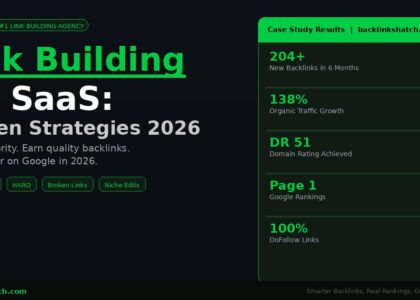
If you are building a business with long-term goals, the answer is clear. Invest in ethical, content-driven link building. Build real relationships with publishers. Create content your industry wants to cite. For SaaS businesses specifically, our in-depth guide covers the exact playbook: Link Building for SaaS: Proven Strategies 2026.
Frequently Asked Questions
What is the simplest way to explain white hat vs black hat link building?
White hat link building earns links by creating value. You write great content, contribute to real publications, and build relationships with editors. Black hat link building tricks search engines into thinking your site is authoritative by using purchased links, automated tools, or fake content networks. One builds real authority. The other fakes it.
Is guest posting white hat or black hat in 2026?
Guest posting is white hat when you write original, valuable content for a relevant site and receive a link in return without a financial transaction for the link itself. It becomes grey or black hat when you pay purely for the link, publish thin or irrelevant content, or use the same article across multiple sites simultaneously.
How long does white hat link building take to show results?
Most white hat campaigns show measurable ranking improvements within three to six months. The timeline depends on your niche competition level, the authority of the sites linking to you, and how consistently you execute your strategy. High-authority placements from major publications produce faster results than links from smaller sites.
Does Google always catch black hat link building?
Google does not catch every black hat tactic immediately, but its detection rate improves with every update. SpamBrain, Google’s AI spam detection system, processes link patterns at scale. What survives today is likely to get flagged in the next major update. The question is not whether Google will catch it but when.
Are paid backlinks always against Google’s guidelines?
Paid backlinks are against Google’s guidelines unless they carry a rel=”sponsored” attribute that tells Google the link was paid for. If a site discloses paid placements correctly, the link carries no SEO value but also no penalty risk. Most link sellers do not use proper disclosure, which puts both parties at risk.
What tools help you identify toxic backlinks?
Ahrefs, Semrush, and Moz all offer backlink audit features. Ahrefs is the most comprehensive for volume and freshness of data. Google Search Console also shows your backlinks but with less detail. Use at least two tools together to get a complete picture of your link profile before running a disavow campaign.
Is white hat link building worth the cost?
Yes. The return on investment for white hat link building compounds over time. A strong editorial backlink from an authoritative site drives referral traffic, improves your domain rating, and lifts your rankings for multiple keywords. Black hat links deliver a temporary boost at the cost of long-term stability. For any serious business, white hat is the only rational investment.
Build Links That Last. Start Today.
The difference between white hat vs black hat link building is not just a technical SEO distinction. It is a business decision. White hat link building protects your domain, your rankings, and your revenue. Black hat tactics put everything you have built at risk for short-term gains that rarely hold.
In 2026, Google’s detection systems are more accurate than ever. SpamBrain flags manipulative links faster than most site owners realize. Manual review teams issue penalties that take months to resolve. The sites winning in organic search are the ones that invested in quality, editorial, and relevant backlinks from day one.
You do not have to figure this out alone. At BacklinksHatch, we have helped 200+ websites build clean, high-authority link profiles through proven white hat strategies including guest posting, digital PR, broken link building, and content-led outreach. Every link we build follows Google’s guidelines. Every placement is editorial and relevant.