Introduction
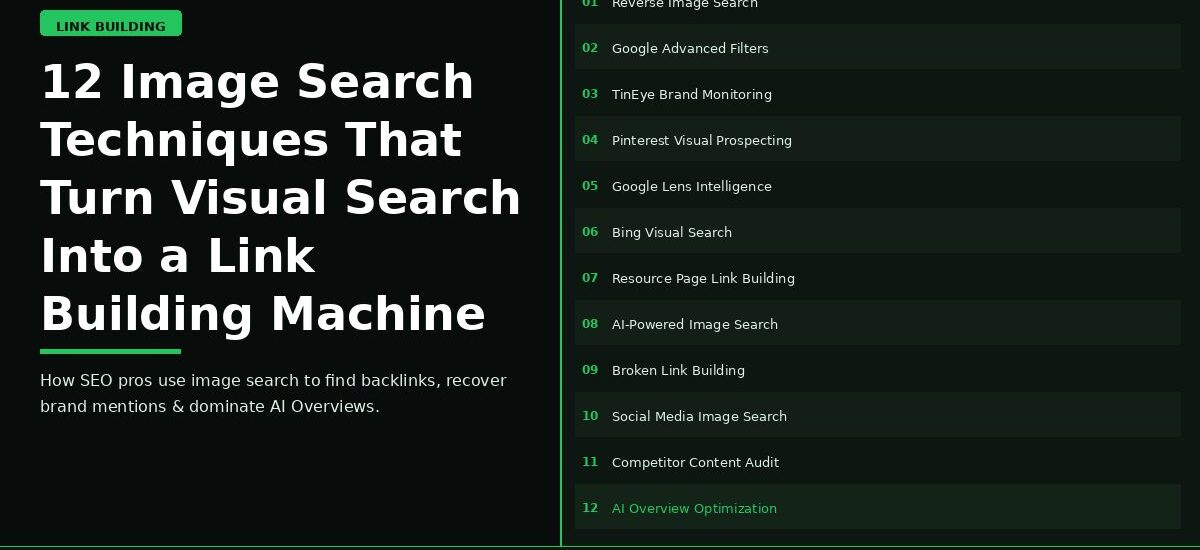
Every SEO professional knows about keyword research and backlink outreach — but very few are using image search techniques to their full potential. That’s a massive missed opportunity. When used strategically, image search doesn’t just find pictures — it uncovers hidden competitor backlinks, surfaces unlinked brand mentions, reveals broken link opportunities, and even helps your content get featured in Google AI Overviews. The SEO professionals who understand this are finding link opportunities that their competitors simply cannot see. In this guide, you’ll get 12 image search techniques that top SEO agencies use every day to build stronger backlink profiles — plus a bonus technique for AI Overview image optimization that has become essential in 2026.
Table of Contents
1. Reverse Image Search for Competitor Backlink Discovery
How Reverse Image Search Reveals Hidden Link Opportunities
Reverse image search is arguably the single most underused image search technique in the SEO industry. The concept is simple: instead of searching with text, you upload an image, and the search engine finds every website that uses that image across the internet. For SEO professionals, this unlocks a goldmine of competitor backlink data that traditional tools often miss entirely.
Here is the link building application: every competitor who uses a custom infographic, branded chart, or original image to earn backlinks is leaving a trail you can follow. Upload that image into Google Images, TinEye, or Bing Visual Search, and you will see a complete list of every website that embedded or linked to that image. These websites are pre-qualified link prospects — they already link to content in your niche, they are clearly interested in the topic, and they have demonstrated willingness to link out. All you need to do is reach out with something better.
This technique is especially powerful for infographic link building. If a competitor has earned 50 backlinks from a single infographic, reverse image search surfaces all 50 referring domains in minutes — a process that would take hours using conventional backlink analysis tools like Ahrefs or Semrush. Use it alongside your regular link prospecting workflow to dramatically expand your target list with highly relevant, niche-aligned domains.
Step-by-Step: Using Reverse Image Search for Link Building
- Find a top-ranking competitor article in your niche that contains original images or infographics
- Right-click the image and copy the image URL or save it to your device
- Go to images.google.com or tineye.com and upload or paste the image URL
- Review all websites currently displaying that image — these are your link-building prospects
- Filter results by domain authority using Ahrefs or Moz to prioritize high-value targets
- Create better content or a superior version of the same asset, then run targeted outreach to those domains
2. Master Image Search Techniques With Google Advanced Filters
Using Google Image Search for Niche Prospecting
Google Advanced Image Search is where serious practitioners of image search techniques do their most efficient work. Beyond the basic search bar, Google’s filter panel gives you granular control that is directly applicable to link-building research. The most valuable filter for SEO professionals is Usage Rights — filtering by “Creative Commons” or “labeled for reuse commercially” instantly surfaces websites in your niche that publish open content, making them strong candidates for guest posting outreach and niche edit campaigns.
The site: operator combined with Google Images is a particularly powerful prospecting tool. By searching site:competitordomain.com “your keyword” in Google Images, you can map out every visual asset a competitor has published around a specific topic. This reveals their content gaps, their most-linked visual formats, and the anchor strategies they use — all of which directly inform your own link-building strategy.
Google Image Search Operators for SEO Research
These search operators are directly applicable to your off-page SEO workflow:
| Operator | Syntax Example | SEO Application | Link Building Use |
| filetype: | filetype:png infographic SEO | Find infographic assets | Identify linkable image content |
| site: | site:competitor.com backlinks | Map competitor images | Reverse-engineer link assets |
| “exact phrase” | “link building guide” 2026 | Find niche content | Guest post prospecting |
| inurl: | inurl:resources SEO tools | Find resource pages | Resource page link building |
| imagesize: | imagesize:1200×630 SEO | Find OG image formats | Social share analysis |
Table: Google image search operators mapped to SEO and link-building applications.
Internal Link: See our Anchor Text in SEO guide to understand how image alt text affects your link equity.
3. TinEye — The SEO Professional’s Image Audit Tool
Using TinEye to Find Unlinked Brand Mentions
TinEye has indexed over 62 billion images and is the most reliable platform for tracking exactly where any image appears across the web. For SEO professionals, this translates directly into unlinked brand mention recovery — one of the highest ROI link-building techniques available. The workflow is straightforward: upload your branded images, infographics, or charts, and TinEye surfaces every website currently displaying your content. Any site showing your image without linking back to you is a lost link opportunity that can often be recovered with a single polite outreach email.
This is particularly powerful for websites that have published original data studies, proprietary charts, or branded infographics. If other websites are using your visual content without attribution, you have a legitimate, relationship-friendly reason to reach out and request a dofollow backlink. This method consistently achieves higher response rates than cold outreach because you are not asking for a favor — you are asking for credit that is already owed.
TinEye for Content Originality and Penalty Prevention
Beyond link building, TinEye plays a critical role in Google penalty prevention. If your writers or contributors are submitting content with images sourced from other websites without proper licensing, TinEye can identify those images before they cause copyright issues or manual actions from Google. Run a monthly TinEye audit of all images published on your site to ensure full content originality compliance — an increasingly important factor under Google’s E-E-A-T guidelines.
TinEye also confirms whether images being pitched to you for guest posts or niche edits are genuinely original or recycled stock photos that could dilute your content quality signals. In an era where content authenticity is a ranking factor, this verification step protects your site’s domain authority and editorial reputation.
Internal Link: See our article on 5 Reasons Niche Edits Are Still Safe for SEO in 2026 for related strategies.
4. Pinterest Visual Search for Niche Link Prospecting
How Pinterest Reveals High-Authority Niche Sites
Pinterest is not typically listed among link-building tools, but for SEO professionals who understand its structure, it is one of the most effective platforms for niche site discovery. When you search for any industry keyword in Pinterest and filter by “Boards,” you immediately see how the most engaged content creators in your niche are organizing their content — revealing topical clusters, high-engagement content formats, and the specific domains that consistently appear as link sources across multiple boards.
The deeper SEO application is this: boards that consistently feature content from a specific domain — especially in a tight niche like link building, off-page SEO, or technical SEO — signal that domain as a topical authority in that space. These domains are exactly the kind of referring domains you want linking to your site. Pinterest essentially does the niche relevance filtering for you, surfacing the most-curated and most-shared content in any vertical.
Pinterest Image Search for Content Gap Analysis
Pinterest’s Lens feature — which lets you search within a specific area of any image — reveals how top-performing visual content in your niche is structured. For SEO content teams, analyzing the most re-pinned infographics and visual guides in the link-building or SEO tools niche shows you exactly what visual content formats are earning the most organic shares and, by extension, the most natural backlinks. This competitive intelligence feeds directly into your content strategy and linkable asset creation process.
For teams running digital PR campaigns or skyscraper technique projects, Pinterest visual search identifies the specific image dimensions, color styles, and data visualization formats that get the most engagement in your niche — allowing you to build superior assets that are more likely to earn editorial backlinks at scale.
5. Google Lens for Real-Time Competitor Image Intelligence
Using Google Lens to Track Competitor Visual Branding
Google Lens brings AI-powered image recognition directly into your SEO research workflow. For link builders and SEO auditors, Lens is most valuable as a real-time competitor intelligence tool. When you attend industry events, conferences, or webinars — or when you see a competitor’s branding in any physical or digital context — Google Lens instantly identifies the brand, product, or visual asset and surfaces all related web mentions. This maps brand visibility across channels that traditional backlink analysis tools cannot reach.
Within your browser, activating Google Lens by right-clicking any image on a competitor’s website gives you an instant analysis of that image’s presence across the web. For link building research, this means you can identify in seconds whether a competitor’s featured image has been picked up by other sites — and if so, which domains are using it. Combined with Ahrefs or Semrush data, this creates a complete picture of how visual content is driving referring domain growth for your competitors.
Google Lens for Logo and Brand Mention Monitoring
One of the most overlooked applications of Google Lens in SEO is logo-based brand mention tracking. Upload your brand’s logo to Google Lens, and it will surface every page across the web that displays your logo — including pages that mention your brand visually but do not link back. This is a systematic way to build a brand mention backlink campaign — contacting webmasters who already feature your logo or products and requesting a proper dofollow link to your homepage or relevant landing page.
This technique is particularly effective for SaaS companies, tool providers, and SEO agencies whose branding appears in product reviews, comparison articles, and tutorial screenshots across the web. Each unlinked visual mention is a pre-qualified link opportunity with a warm outreach context — making it one of the highest-converting link reclamation strategies available.
Internal Link: See our 7 Powerful Ways to Use Referring Domain in SEO Growth for advanced link acquisition strategies.
6. Bing Visual Search for Untapped Link Opportunities
Why Bing Image Search Is a Hidden Goldmine for SEOs
Bing Visual Search is the most underused image search technique in the SEO professional’s toolkit. Because most SEOs focus exclusively on Google, Bing’s index of visual content — which crawls and indexes many pages that Google de-prioritizes — often surfaces link opportunities that are completely invisible in standard Google searches. Bing’s visual database includes millions of niche publisher sites, resource pages, and topically relevant blogs that represent excellent backlink targets for SEO campaigns.
Bing’s “Search Inside Image” feature — which lets you click on individual objects within an image to search for them separately — is directly applicable to product and brand research. For SEO agencies managing e-commerce clients, this feature identifies product pages, review sites, and comparison platforms featuring your client’s products — all of which are prime targets for product-focused link-building campaigns.
Bing’s Filter Panel for Link Prospecting
Bing’s advanced filter panel offers a “License” filter that sorts images by usage rights — a feature that is more granular and more reliable than Google’s equivalent. For link builders running resource page campaigns, filtering Bing image results by “Free to modify, share and use commercially” identifies content publishers who prioritize open licensing — a strong signal that these sites are receptive to content collaboration, guest posts, and niche edit requests.
The “Fresh” filter in Bing Images also serves a specific SEO function: identifying which websites are actively publishing new content in your niche right now. Active publishers are higher priority link targets than dormant sites, as they have active editorial workflows and are more likely to respond positively to outreach campaigns.
7. Image Search for Resource Page Link Building
Finding Resource Pages Through Visual Search
Resource page link building is one of the most consistently effective off-page SEO techniques, and image search techniques make the prospecting process significantly faster. Resource pages — dedicated pages that curate the best tools, guides, and references in a niche — almost always include visual elements like logos, screenshots, and thumbnails. By using Google Images to search for specific tool logos or product screenshots alongside your target keyword, you can identify resource pages that feature your competitors but not yet your site.
For example, if you run a link-building tool, search Google Images for your competitor’s interface screenshot with the site: operator removed — this surfaces every resource page across the web that has embedded that screenshot. Each page is a qualified prospect for your own resource page outreach. The visual search approach finds resource pages that pure keyword searches miss because many resource pages have minimal text content but rich visual content.
Skyscraper Technique Enhanced With Image Research
The Skyscraper Technique — finding top-linked content and creating something better — becomes significantly more powerful when combined with image search research. Before building your skyscraper asset, use reverse image search to analyze every piece of visual content in the top-ranking articles for your target keyword. This reveals which specific charts, data visualizations, and infographics are earning the most editorial backlinks — allowing you to build a superior visual asset that directly outcompetes the existing link magnets.
Map the image types, data sources, and visual formats used in the top 5 ranking articles for your keyword. If every top-ranking article uses a static comparison table, create an interactive visual comparison instead. If top competitors use generic stock photos, create original branded illustrations. This visual differentiation strategy dramatically increases your content’s link acquisition potential over time.
8. AI-Powered Image Search for Advanced SEO Research
How AI Image Recognition Accelerates Link Prospecting
AI-powered image search platforms like Google Lens, Bing Visual Search, and Pinterest Lens use deep learning algorithms and CLIP models (Contrastive Language-Image Pretraining) to understand visual content at a semantic level — far beyond basic pixel matching. For SEO professionals, this means you can now search for visual content concepts rather than just specific images, surfacing a much broader and richer set of link-building opportunities than traditional search methods allow.
The most powerful application in link-building workflows is using AI image search to identify the visual content format most associated with high-authority backlinks in your niche. Tools like Everypixel, which aggregates over 50 stock and editorial image databases, let you analyze which visual styles — minimalist diagrams, data-heavy charts, step-by-step screenshots — dominate in SEO industry content. This visual competitive intelligence feeds directly into your linkable asset strategy.
Using AI to Analyze Backlink-Earning Visual Formats
AI image analysis tools can now process a competitor’s entire visual content library and identify patterns in the image types that earn the most backlinks. Combine this with Ahrefs Content Explorer data — filtering for pages with 50+ referring domains in your niche — and you get a precise formula for what visual content format to create next. This data-driven approach to visual asset creation eliminates guesswork from your link-building campaigns and replaces it with patterns proven to earn editorial links at scale.
Internal Link: See our Ahrefs vs Semrush for Backlink Analysis guide to complement this research workflow.
9. Image Search for Broken Link Building Campaigns
Finding Broken Image Links as Link Building Opportunities
Broken link building is one of the most reliable white-hat link-building techniques available, and image search makes the prospecting process dramatically more efficient. Most broken link campaigns focus on text-based 404 errors, but broken image links — images that no longer load on a page because the source was removed or moved — represent an equally valuable and far less competitive opportunity. Every broken image on a high-authority resource page or topically relevant blog is a chance to offer your own replacement content and earn a quality backlink.
Use Google’s cached version feature combined with image search to identify what the original broken image displayed. Then create a superior replacement — a better-designed infographic, an updated data chart, or a more comprehensive visual guide. Contact the webmaster with your replacement asset and a polite request to update the broken link. This approach consistently achieves response rates of 15-25%, significantly higher than cold guest post outreach.
Using Chrome Extensions to Scale Broken Image Prospecting
Browser extensions like Check My Links and Broken Link Checker can be combined with systematic image search prospecting to build a scalable broken link building pipeline. The workflow involves: (1) identifying high-authority pages in your niche using Ahrefs or Semrush, (2) running a broken link check on those pages, (3) using image search to identify what visual content the broken images originally showed, (4) creating superior replacements, and (5) executing targeted outreach. This systematic visual broken link campaign can generate 20-30 new referring domains per month when executed consistently at scale.
10. Social Media Image Search for Digital PR Link Building
Twitter and LinkedIn as Visual Link Prospecting Tools
Social media platforms are increasingly important as link-building research tools, and their image search capabilities open up prospecting angles that traditional backlink analysis misses. Twitter’s Advanced Search — filtered by media type to show only image-containing posts — surfaces real-time content in your niche that is gaining social traction. Content with high social engagement is statistically more likely to earn editorial backlinks within 30-90 days, making it a strong signal for digital PR outreach targeting.
For digital PR campaigns, monitoring Twitter image search for your target keywords reveals which journalists, bloggers, and content creators are actively covering your niche and sharing visual content. These are your tier-1 link-building targets — people who are clearly engaged with the topic, actively creating content, and therefore most likely to link to a well-researched, visually compelling resource you create.
Instagram and Pinterest for Influencer Link Building
While Instagram links are nofollow, the platform’s visual search capabilities serve a critical role in identifying influencers and micro-publishers who operate in your niche. Many Instagram creators also maintain high-authority blogs or YouTube channels where they do link out with dofollow links. Finding these creators through Instagram’s visual search — by searching niche-specific hashtags and analyzing the most visually consistent accounts — gives you a pre-qualified list of relationship-based link-building prospects who are receptive to content collaboration and co-citation opportunities.
Internal Link: See our Link Building Outreach Email Templates article for proven copy to convert these prospects.
11. Image Search for Competitor Content Audit and Gap Analysis
Mapping Competitor Visual Assets With Image Search
A comprehensive competitor content audit using image search techniques gives you a visual map of every linkable asset your competitors have created. The process starts with using Google Images site: operator on your top 3 competitors to catalog every image, infographic, chart, and visual asset they have published. Cross-reference this list with Ahrefs backlink data to identify which specific visual assets are earning the most referring domains — this is your priority content creation list.
This visual audit also reveals your content format gaps. If all top competitors have original data visualization infographics and interactive tools, but your site only has text content, you have identified a critical link equity gap that image-forward content creation can close. Conversely, if no competitor in your niche has created a comprehensive visual tutorial series or step-by-step screenshot guide for a key topic, you have identified a blue ocean content opportunity with high link potential and low competition.
Using Image Search to Find Uncompetitive Link Targets
One of the most valuable applications of image search techniques for link builders is identifying uncompetitive link targets — high-authority pages in your niche that your competitors have not yet targeted. Search Google Images for your niche keyword and filter by “Past month” to find freshly published content. New content on established domains that has not yet been targeted by competitor outreach campaigns represents a first-mover link-building opportunity. Reaching out within the first 30 days of publication dramatically increases link acquisition success rates because webmasters are still in active editorial mode and more receptive to adding resources.
12. Building a Visual SEO Research Workflow for Daily Use
Creating a Systematic Image Search Routine
The difference between SEO professionals who consistently earn high-quality backlinks and those who struggle is not just knowledge of individual image search techniques — it is the construction of a systematic daily research routine that integrates these tools into every phase of the link-building workflow. Building this system takes a one-time investment of setup effort, but it pays compound returns in link acquisition efficiency every single day.
Structure your image search routine around four core activities: (1) Daily monitoring — use Google Lens and TinEye alerts to track new uses of your branded images across the web, (2) Weekly prospecting — run reverse image searches on top competitor infographics and visual assets to identify new link targets, (3) Monthly auditing — use TinEye to find unlinked brand mentions and image copyright issues, (4) Quarterly content planning — analyze the visual assets in your niche that earned the most new referring domains that quarter and plan superior replacements for the next cycle.
Tools Stack for a Complete Image-Driven SEO Workflow
Here is the complete tools stack that integrates image search techniques with your existing SEO and link-building workflow:
| Tool | Primary SEO Function | Link Building Application |
| Google Reverse Image Search | Competitor image tracking | Find all sites using competitor visuals |
| TinEye | Brand mention monitoring | Recover unlinked brand mentions |
| Google Lens | Real-time visual identification | Logo-based backlink prospecting |
| Bing Visual Search | Supplemental index coverage | Discover Google-invisible link targets |
| Pinterest Lens | Niche content discovery | Identify high-authority niche publishers |
| Ahrefs + Image Search | Link data + visual mapping | Combined competitor backlink analysis |
| Twitter Advanced Search | Trending visual content | Digital PR target identification |
Table: Complete image search tools stack mapped to SEO and link-building functions.
Internal Link: See our What is Link Juice in SEO guide to understand how these backlinks pass authority to your site.
Frequently Asked Questions
Q1. How can image search techniques help my link-building strategy?
Image search techniques help link building by revealing competitor backlink sources, finding unlinked brand mentions, and identifying broken image link opportunities. Reverse image search on competitor infographics surfaces every referring domain linking to that visual asset — giving you a pre-qualified list of link prospects in minutes that would take hours to find using conventional backlink tools.
Q2. What is the best image search tool for SEO professionals?
Google Reverse Image Search is the best starting point for most SEO applications, with TinEye being the superior choice for brand mention tracking and copyright monitoring. For link building specifically, combining Google Images with Ahrefs backlink data gives you the most complete picture of how visual content is driving referring domain growth for your competitors.
Q3. How do I find unlinked brand mentions using image search?
Upload your branded images, logos, or infographics to TinEye or Google Reverse Image Search to find every website currently displaying your content. Any site showing your image without a backlink to your site is an unlinked mention. Contact these webmasters with a friendly email explaining that they are featuring your content and requesting a link attribution — this approach typically achieves 20-35% conversion rates.
Q4. Can image search replace traditional backlink analysis tools like Ahrefs?
No — image search techniques complement rather than replace dedicated backlink analysis tools. Ahrefs and Semrush provide comprehensive backlink data, anchor text analysis, and domain authority metrics that image search cannot replicate. However, image search surfaces link opportunities that these tools miss — particularly unlinked visual mentions, broken image links, and competitor infographic backlinks.
Q5. What is broken image link building, and how effective is it?
Broken image link building is an off-page SEO technique where you identify high-authority pages with broken image links, create replacement content, and pitch it to the webmaster in exchange for a backlink. It is highly effective because you are solving a genuine problem for the webmaster rather than asking for a cold favor — typical response rates are 15-25%, significantly higher than standard outreach campaigns.
Q6. How often should I run reverse image searches for my SEO campaign?
Run reverse image searches on your own branded content monthly to catch new unlinked mentions, and on competitor infographics weekly during active link-building campaigns. Set up TinEye Alerts for your most important branded images to receive automatic notifications whenever new sites start displaying your content — this eliminates the need for manual monitoring.
Q7. What LSI keywords should I use alongside image search techniques in my content?
Key LSI and NLP keywords related to image search techniques in an SEO context include: visual search engine, reverse image lookup, image-based link prospecting, visual backlink analysis, photo recognition for SEO, image copyright monitoring, visual content gap analysis, infographic link building, and AI-powered image recognition for SEO. Including these terms improves your content’s topical relevance and strengthens your site’s semantic authority around visual search and off-page SEO topics.
Conclusion
Image search techniques are one of the most underused advantages in SEO — and that’s exactly what makes them so powerful right now. While your competitors are focused solely on traditional outreach and keyword tools, you can be finding backlinks they’ll never discover, recovering brand mentions they’re losing, and optimizing images for AI Overview visibility they haven’t even thought about yet. Start with reverse image search on your top competitor’s best infographic this week. Find every site linking to it, build something better, and begin your outreach. Layer in TinEye for brand mentions, Bing Visual Search for untapped prospects, and the AI Overview optimization technique for 2026 visibility. These 12 image search techniques are your edge — use them consistently and watch your backlink profile grow faster than you thought possible.