Introduction
Every SaaS company wants more organic traffic. But without strong backlink acquisition, even the best product pages stay buried on page 3.
Link building for SaaS is different from standard link building. You are selling software, not physical products. Your buyers are technical. Your content needs to earn trust before it earns clicks.
This guide gives you a clear, tested roadmap. You will learn how to build high-authority backlinks, grow your domain rating, and outrank competitors in 2026. Whether you are starting from zero or want to scale an existing strategy, these tactics work.
Need professional link-building services to speed up your results? Visit BacklinksHatch to explore expert-led solutions built for SaaS growth.
1. Why SaaS Link Building Is Unique
SaaS companies face specific challenges in off-page SEO. Your sales cycle is long. Your product is invisible without a demo. And most link-building tactics built for e-commerce or blogs do not translate directly.
Here is what makes SaaS link building different:
- You target decision-makers, not casual browsers
- Your content must demonstrate product-led value
- Links need to come from industry-relevant domains
- Topical authority matters more than sheer link volume
Google evaluates SaaS sites under stricter E-E-A-T signals (Experience, Expertise, Authoritativeness, Trustworthiness). A link from a niche B2B publication beats 10 links from generic directories.
The SaaS Buyer Journey and Link Context
Understanding your buyer changes your link strategy. A SaaS buyer moves through awareness, consideration, and decision stages. Each stage needs a different type of content and a different type of backlink.
At the awareness stage, links from thought leadership articles, industry newsletters, and research roundups work best. These links bring in cold traffic from people who match your ideal customer profile (ICP). They discover your brand through trusted third-party sources. This is how you build brand recognition before someone even searches for your product category.
At the consideration stage, links from software review platforms like G2, Capterra, and Trustpilot add trust signals. These are high-intent pages. Buyers visit them right before making a decision. A strong presence here, backed by quality backlinks pointing to your review profiles, builds serious credibility.
At the decision stage, links from comparison pages and case study roundups push undecided buyers over the line. When a respected blog links to your vs-competitor page, it sends conversion-ready traffic directly to your funnel.
Domain Authority vs. Topical Relevance
Many SaaS teams chase domain authority (DA) scores alone. A DR 90 link from a fashion blog adds almost nothing to a project management SaaS. A DR 55 link from a productivity-focused newsletter moves the needle significantly.
Focus on topical relevance first. Ask: Does this site publish content your ideal customer reads? If yes, pursue the link. If no, skip it regardless of the DA score.
Build a link relevance scoring system internally. Score prospects on three factors: domain authority, topical fit, and audience overlap. Prioritize sites that score well on all three, not just one. This approach keeps your backlink profile clean and powerful.
According to Ahrefs research, the strongest SaaS backlink profiles combine topical relevance with consistent domain diversity across referring domains.
2. Link Building for SaaS: Core Strategies That Work in 2026
Link building for SaaS requires a mix of owned assets and active outreach. This section covers the most effective and scalable link-building tactics for SaaS businesses right now.
Original Research and Data Studies
Data-driven content earns editorial backlinks naturally. When you publish original research, other writers cite you. It is one of the highest-ROI content formats in B2B SaaS.
Here is the process:
- Survey your existing customers (minimum 200 responses)
- Pull anonymized product usage data to find industry trends
- Present findings with clear charts and a downloadable report
- Pitch the data to journalists and bloggers covering your niche
A single strong data study generates 30 to 80 backlinks over 12 months. Reporters and bloggers need fresh statistics. Give them yours, and they link back to your site as the primary source.
Tools like Typeform for surveys and Tableau for data visualization make this faster. Publish findings on a dedicated research page. Optimize it with structured data markup so search engines surface it in featured snippets and AI-generated answer boxes.
The key is publishing research that your industry does not already have. Do not replicate existing studies. Find a gap. Ask a question nobody has answered with real data yet. That is where your linkable asset lives.
Read more about the proven benefits of guest posting for SEO to understand why content-based link building compounds over time.
Strategic Guest Posting on B2B Publications
Guest posting works when you target the right publications. Generic blogs waste your time. Niche B2B sites with engaged readerships build real referral traffic alongside SEO value.
Target publications that:
- Publish content that your ICP reads weekly
- Have a domain rating above 50
- Accept bylined articles with contextual links
- Cover topics adjacent to your product category
Pitch articles that solve specific problems. ‘How to reduce customer churn in SaaS’ beats ‘Tips for SaaS growth’ every time. Specific titles get accepted faster and drive more qualified traffic.
Include one contextual link to a relevant page on your site. Do not link to your homepage. Link to a blog post, a data study, or a feature page that adds genuine value to the article’s readers.
Build relationships with editors before you pitch. Comment on their content. Share their articles. Engage on LinkedIn. A warm pitch gets a response rate 3x higher than a cold email. Learn how to find guest post sites in your niche to build a strong prospect list fast.
3. Technical Link Building Tactics
Technical tactics attract fewer competitors because they require more effort. That is exactly why they work.
Broken Link Building at Scale
Broken link building is a reliable white-hat tactic. Find broken links on relevant websites. Offer your content as a replacement. You solve a problem for the webmaster and earn a backlink in return.
The process:
- Step 1: Use Ahrefs or Semrush to find broken outbound links on competitor resource pages
- Step 2: Check which broken page your content closely matches
- Step 3: Email the site owner with the broken link URL and your replacement
- Step 4: Keep your outreach short and helpful, not salesy
Focus on resource pages, tool lists, and ‘best of’ articles. These pages accumulate broken links over time as old tools shut down or URLs change. SaaS tool directories are especially productive for this tactic.
Track your outreach in a spreadsheet. Log the target URL, the broken link, your replacement URL, outreach date, and response status. Follow up once after 7 days. Do not follow up more than twice.
For a deeper comparison of link-building methods, read this breakdown of guest posting vs niche edits to choose the right approach for your situation.
HARO and Expert Positioning
Help a Reporter Out (HARO), now known as Connectively, connects journalists with expert sources. Responding to relevant queries earns you press mentions and editorial backlinks from high-authority news sites.
Check queries three times per day. Respond within 2 hours of receiving a query. Journalists work on deadlines. Fast responses win placements.
Write responses that are specific and quotable. Give a clear opinion. Back it with a data point or a real customer example. Avoid vague answers that sound like marketing copy.
Position your CEO, Head of Product, or a senior team member as the expert. Journalists prefer to quote named individuals with verifiable credentials. Build a short bio for each spokesperson and attach it to every HARO response.
Over 6 months of consistent HARO responses, a focused SaaS team earns 8 to 15 placements in outlets with a domain authority above 70. Each placement builds brand recognition alongside organic search authority.
4. Partnership and Community Link Building
Your existing network is an underused link-building asset. Integration partners, technology ecosystems, and niche communities all hold link opportunities that most SaaS teams ignore.
Integration and Technology Partner Links
If your SaaS integrates with other tools, you have a direct path to backlinks. Every integration partner has a partner directory or integrations page.
Steps to activate this channel:
- List every tool your product integrates with
- Find the partner or integrations page on each tool’s website
- Reach out to their partnership team with a short email
- Request a mutual listing with a link to your integrations page
Zapier, HubSpot, and Salesforce all have partner ecosystems with thousands of listed apps. Getting listed takes one email and provides a permanent, high-authority backlink. These links come from domains with DR 80 or higher and cost you nothing but a short application.
Technology partner links also drive qualified referral traffic. Someone browsing the Zapier app directory and clicking your listing is already in a buying mindset. These visitors convert at higher rates than cold organic traffic.
Community Contributions and Resource Links
SaaS communities on Reddit, Slack groups, and niche forums contain resource pages and wiki-style articles. Contributing genuine value in these spaces builds both reputation and contextual backlinks.
Find the top 10 communities where your ICP spends time. Participate consistently for 30 days before posting any links. Answer questions. Share data. Offer real opinions.
Once you have built credibility, suggest your content organically when it genuinely helps someone. Moderators and community managers notice quality contributors. They often add helpful resources to pinned posts or resource wikis.
Sponsor niche newsletters in your category. Most B2B newsletters with 5,000 to 50,000 subscribers charge $200 to $1,500 per issue. Sponsorships include a linked mention with strong topical authority and direct audience targeting.
5. Link Building Tools and Workflow
You need the right tools to scale your outreach without losing quality. Here is a reference table of the top tools used in SaaS link building in 2026.
| Tool | Primary Use | Best For | Cost |
| Ahrefs | Backlink analysis, competitor gaps | Finding link prospects at scale | Paid |
| Semrush | Link audits, toxic link removal | Technical backlink analysis | Paid |
| Hunter.io | Email finding for outreach | Locating editor contacts | Freemium |
| Pitchbox | Outreach automation | Large-scale guest post campaigns | Paid |
| BuzzStream | Relationship management | HARO and partnership outreach | Paid |
| Screaming Frog | Site crawling | Broken link discovery | Freemium |
| Google Search Console | Performance monitoring | Tracking backlink impact on traffic | Free |
Build a weekly workflow around these tools. Spend 2 hours per week on prospecting, 2 hours on outreach, and 1 hour on follow-ups. Consistency beats intensity in link building.
Also, track your Google Search Console data weekly. It shows which pages are gaining referring domain signals and which keywords are responding to your link building. See our guide on Google Search Console features you are likely ignoring to maximize this free tool.
6. Case Study: How a B2B SaaS Company Built 200 Backlinks in 6 Months
Company: Mid-size project management SaaS (anonymized)
Starting Domain Rating: 28
Goal: Reach DR 50 and rank for 3 high-volume target keywords
Strategy Used:
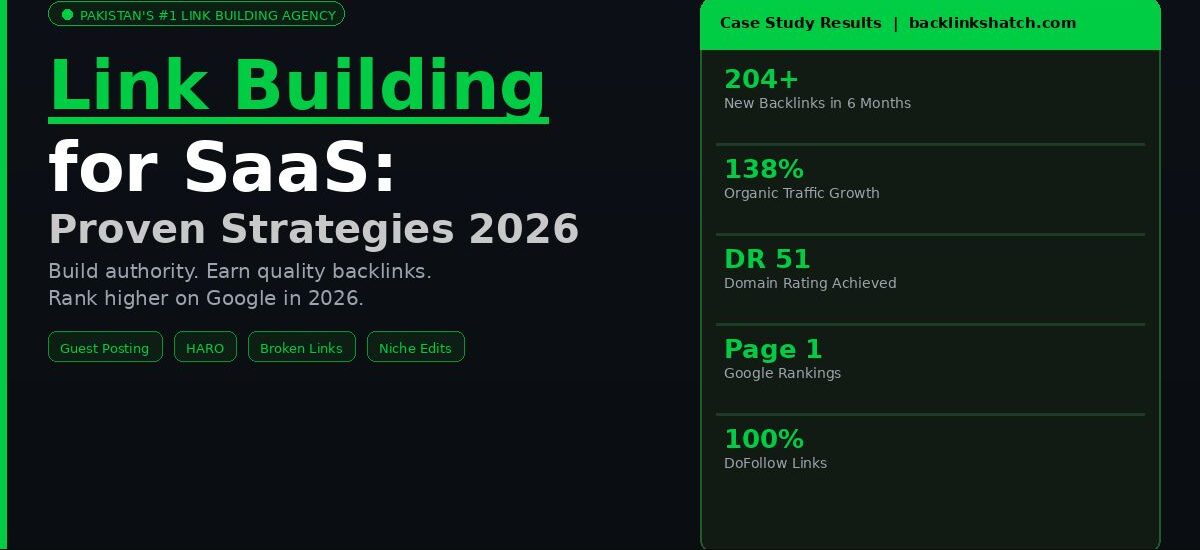
The team combined three tactics. First, they published an original research report titled ‘State of Remote Team Productivity 2025’ based on a survey of 450 SaaS employees. Second, they ran a targeted guest posting campaign on 12 B2B productivity publications. Third, they responded to HARO queries daily for 90 days.
Results After 6 Months:
- 204 new referring domains acquired
- Domain Rating increased from 28 to 51
- Organic traffic grew 138%
- 2 of 3 target keywords reached page 1
Key Lesson:
The research report generated 89 backlinks on its own. One piece of original data attracted links from 23 different domains without any active outreach. Journalists found it through Google and cited it.
The combination of owned assets and active outreach produced compound results. Neither alone would have achieved the same outcome in the same timeframe. This validates what Moz’s backlink guide describes as the content-outreach compounding effect.
7. Link Building for SaaS: Common Mistakes to Avoid
Link building for SaaS produces results when you avoid these common errors.
- Buying low-quality links from link farms or PBNs. Google penalizes these and removes ranking gains fast.
- Ignoring anchor text diversity. Over-optimizing with exact-match keywords triggers manual penalties. Use branded, generic, and partial-match anchors.
- Targeting irrelevant domains. A high DA score from an unrelated niche adds minimal SEO value.
- Stopping after 30 days. Link building compounds over time. Teams that stop early lose momentum and see their rankings stall.
- Skipping link audits. Toxic backlinks harm your profile. Run a full backlink audit every quarter using Ahrefs or Semrush.
- Linking only to your homepage. Distribute links across deep pages, blog posts, and feature pages for maximum SEO impact.
According to SEOmator’s 2025 backlink data report, 95% of all web pages have zero backlinks. Avoiding these mistakes puts you ahead of the vast majority of competitors from day one.
8. Measuring Link Building Success
Track these key performance indicators (KPIs) monthly:
- Number of new referring domains
- Average DR of acquired links
- Organic keyword ranking changes for target pages
- Referral traffic from linked domains
- Domain Rating growth over time
- Anchor text distribution across your backlink profile
Set a 6-month baseline before judging results. SEO operates on a delay. Links acquired today show ranking impact in 8 to 12 weeks on average.
Build a simple dashboard in Google Looker Studio that pulls data from Google Search Console and Ahrefs. Review it every Monday morning. Adjust your outreach targets based on what is working.
For content-led link building to work at scale, your on-page SEO needs to be solid first. Read how to run a full SEO audit in 2026 before scaling your outreach.
Frequently Asked Questions
How long does link building for SaaS take to show results?
Most SaaS sites see measurable ranking improvements 8 to 16 weeks after building quality backlinks. Domain authority growth takes 3 to 6 months of consistent effort. Patience is part of the strategy.
How many backlinks does a SaaS site need to rank on page 1?
It depends on your competitors. Use Ahrefs to check the referring domain count of the top 3 results for your target keyword. Match or exceed that number with higher-quality links. Quality beats quantity every time.
Is guest posting still effective in 2026?
Yes, when done on relevant, high-quality publications. Mass guest posting on low-quality sites no longer works. Targeted outreach to niche B2B publications still drives strong results. Learn more in our complete guide to guest posting.
What is the best free link-building tactic for early-stage SaaS?
HARO outreach costs nothing but time. It earns high-authority press links and builds brand visibility simultaneously. Start here before investing in paid tools or sponsored placements.
Should SaaS companies use link-building agencies?
Agencies work well when you have a clear brief and a quality benchmark. Vet agencies by asking for samples of recent placements. Reject any agency that cannot show links to real editorial publications.
How do I find link-building prospects for my SaaS niche?
Search Google for ‘best tools for your category’ and ‘top software in your niche.’ Reach out to the authors of those articles. Offer to add your tool or contribute an expert quote. These pages already rank and already link to competitors.
What is the difference between dofollow and nofollow links for SaaS?
Dofollow links pass SEO authority from one site to yours. No-follow links do not pass authority directly but still drive referral traffic and diversify your backlink profile. A natural profile contains both. Focus on dofollow from high-authority sources, but do not discard nofollow links from high-traffic publications.
Conclusion
Link building for SaaS is not optional in 2026. It is the foundation of sustainable organic growth.
You now have the strategies, tools, and workflow to build a serious backlink profile. Start with original research. Add guest posting and HARO. Activate your integration partners. Measure everything.
Results come from consistency. Pick two tactics. Execute them for 90 days. Then layer in more. That is how SaaS companies build domain authority that compounds year after year.
Ready to accelerate your results? Explore professional guest post services at BacklinksHatch and start building links that move the needle.