Small businesses often compete against brands with 10x their budget. You do not need a massive marketing team to win at SEO. You need the right link building strategies for small businesses that actually move the needle in 2026. This guide breaks down what works, what has changed, and how you build authority without burning your budget. Whether you are a local shop, a freelancer, or a growing agency, the tactics in this article are practical, tested, and built for businesses with limited time and resources.
1. Why Link Building Still Matters in 2026
The Role of Backlinks in Google’s Ranking Algorithm
Google’s algorithm has evolved significantly. But one thing stays constant. Backlinks remain a top-three ranking factor. A 2024 study by Ahrefs confirmed that 96.55% of pages get zero organic traffic. The main reason is a lack of backlinks. For small businesses, this is both a challenge and an opportunity. Your local competitors are likely ignoring link building completely. That is your opening.
Understanding three core terms helps you make smarter decisions:
Domain Authority (DA): A score that predicts how well your site ranks. Higher DA from linking sites passes more SEO value to your pages.
Referring Domains: The number of unique websites linking to you. One site linking 100 times is worth less than 100 different sites linking once.
Link Equity: The SEO value passed through a backlink. It depends on the linking page’s authority and its relevance to your content.
Small businesses do not need thousands of links. They need the right links from relevant, trusted sources. To understand the full picture of white hat vs black hat link building, read this detailed breakdown before you start any outreach campaign.
How Backlinks Impact Your Local Search Visibility
Local search is where most small businesses win or lose. When someone searches for a service near them, Google looks at three main signals: relevance, distance, and prominence. Backlinks directly influence prominence.
A strong backlink profile signals to Google that your business is trusted and authoritative in your geographic area. Local news mentions, city directory listings, and links from regional business associations all tell Google your business matters to the local community.
One important question most business owners have is: how long before you see results? The answer depends on your current authority and competition level. For a deeper look at this, read how long it takes for backlinks to affect rankings so you set realistic expectations from day one.
According to Moz’s research on local search ranking factors, link signals consistently rank among the top five factors influencing local pack results. This data has remained stable across multiple years, confirming that local link building is not optional for small businesses serious about organic growth.
2. Best Link Building Strategies for Small Businesses
Guest Posting on Niche-Relevant Websites
Guest posting is one of the most reliable link building strategies for small businesses in 2026. You write content for another website in your industry. They publish it with a contextual link back to your site. This works because the link comes from a relevant, trusted source. Google weighs topical relevance heavily. A guest post on a local business blog or an industry-specific site carries far more SEO value than a random directory listing.
Here is how to execute guest posting correctly:
- Find sites in your niche with a DA of 30 or above using tools like Ahrefs, Moz, or SEMrush.
- Pitch a specific topic that solves a real problem for their audience.
- Write content that educates and adds genuine value to that site’s readers.
- Place your link naturally in the body content, not just the author bio.
- Follow up after publishing and share the post across your own channels.
To learn exactly where to find the right platforms, read this guide on how to find guest post sites in your niche. It covers five free methods that work even if you have no existing relationships in your industry.
Many small businesses skip guest posting because it feels slow at first. But a single guest post on a strong site builds organic search visibility that compounds over months and years. If you are comparing approaches, also check out the differences between guest posting vs niche edits to decide which tactic fits your goals.
Guest Post Quality Checklist: Metrics to Verify Before Pitching
| Metric | Minimum Target | Why It Matters |
| Domain Authority (DA) | 30+ | Ensures the link passes meaningful SEO value |
| Monthly Organic Traffic | 1,000+ | Confirms the site has a real audience |
| Spam Score | Below 5% | Protects your site from toxic link association |
| Niche Relevance | Must match niche | Topical relevance multiplies link value |
| Do-Follow Link Confirmed | Yes | Ensures the link actually transfers equity |
| Content Quality on Site | High editorial bar | Google rewards links from quality publishers |
Local Citations and Business Directory Links
Local businesses consistently underestimate how powerful local SEO citations are for link building. A citation is any online mention of your business name, address, and phone number (NAP). When that citation includes a clickable link, it becomes a backlink with real authority signal value for your local rankings.
Start with the foundational directories that Google trusts most. These include Google Business Profile, Bing Places, Yelp, Apple Maps, and Foursquare. All of these are free to list on and carry strong domain authority. After covering the foundations, move to niche-specific directories. A restaurant should be on Zomato and TripAdvisor. A law firm should be on Avvo and FindLaw. A contractor should be on Houzz and Angi.
Consistency is more important than quantity here. Your NAP consistency across every listing must be exact. One directory showing ‘St.’ while another shows ‘Street’ creates conflicting signals that hurt your local pack rankings. Aim for 40 to 60 quality citations before you move to more advanced link-building methods. Tools like BrightLocal or Whitespark help you audit and manage citations efficiently.
According to Google’s own local search documentation, prominence in local search is heavily influenced by the information Google finds about your business across the web. Consistent citations directly support that prominence signal.
3. Digital PR and Earning Editorial Links
How to Get Featured in Online Publications
Digital PR is the process of getting your business mentioned in news articles, industry reports, and online publications. These editorial backlinks are among the most powerful in SEO because you earn them based on merit and expertise. They are also among the most trusted link types in Google’s eyes because they are not paid placements.
You do not need a PR agency. You need a clear strategy and consistent execution.
The most effective free method is HARO (Help a Reporter Out), now operating as Connectively at helpareporter.com. Journalists post questions daily, looking for expert sources. You respond with a useful, specific quote. If selected, you earn a mention and often a do-follow link in a major publication with high domain authority.
Other methods that work for small businesses:
- Publish original data or a local survey and pitch it to regional news outlets.
- Create a free tool or resource that journalists in your niche reference regularly.
- Sponsor a local event and earn links from the event page and related press coverage.
- Comment on trending news in your industry with a unique perspective and offer yourself as an expert source.
Speed matters with digital PR. Journalists work on tight deadlines. Respond within 30 minutes of seeing a relevant query. Include specific numbers and real experience in your response. Generic replies never get selected.
Building Relationships with Industry Bloggers and Influencers
Relationship-based link building is slower than other tactics. It is also highly effective and resistant to algorithm changes. Links that come from genuine professional relationships carry trust signals that paid links never replicate.
Identify 20 to 30 bloggers and content creators in your niche. Follow them on social media and subscribe to their newsletters. Comment on their posts with genuine, detailed insight. Share their content without asking for anything in return. After two to three months of consistent engagement, reach out with value first.
Offer to collaborate on content, share proprietary data, or contribute a section to a post they are currently writing. When you build a real relationship, earned backlinks come naturally. These are the links Google trusts most because they reflect genuine endorsement from a peer in your industry.
For small businesses wanting to understand the full benefits before investing time in this approach, this article on the proven benefits of guest posting for SEO covers what you gain beyond just rankings, including referral traffic and brand authority.
4. Content-Driven Link Acquisition
Create Linkable Assets That Attract Backlinks Naturally
A linkable asset is a piece of content so useful that other websites want to reference it. This is a foundational part of any serious link building strategies for small businesses’ playbook because it shifts you from chasing links to attracting them. The four types of linkable assets that consistently generate backlinks in 2026 are:
Original research and industry statistics. Survey your customers or analyze publicly available data in your niche. Publish the findings with clear charts and context. Writers across your industry look for statistics to cite. If your data is accurate and relevant, they link to it naturally.
Comprehensive guides and how-to content. A 3,000-word guide on a specific problem your audience faces earns links over time. Other sites reference it instead of writing the same guide themselves.
Free tools and calculators. A local accountant who builds a free tax estimation calculator gets linked from finance blogs, Reddit threads, and resource pages for years after publishing.
Infographics with embedded codes. Visual content is simple to share. When you add an embed code below your infographic, you make it easy for other sites to use your content and automatically link back to you.
The key with linkable assets is active promotion. Create the asset first. Then email 50 relevant sites in your niche and let them know it exists. Most backlinks from content do not arrive passively. You promote the asset, then the links follow.
Ahrefs published research showing that content with original data earns 3x more backlinks than content that simply aggregates existing information. This makes original research the highest-ROI content investment for small businesses with limited budgets.
Skyscraper Technique and Broken Link Building
Two specific tactics produce strong results for small businesses working with limited outreach resources. Both are built around offering genuine value to the site owner, which dramatically increases your response rate compared to cold link requests.
The Skyscraper Technique: Find a popular piece of content in your niche that already has many backlinks. Create a better version. It should be more detailed, more current, or more visually useful than the original. Then reach out to the sites currently linking to the original and show them your improved version. Many will update their link because it serves their readers better.
Broken Link Building: Use a tool like Check My Links or Ahrefs to find broken links on relevant websites in your niche. These are links pointing to pages that no longer exist. Reach out to the site owner, notify them of the broken link, and suggest your relevant content as a working replacement. You are solving their problem, not just asking for a favor.
Both tactics work because they frame your outreach around the site owner’s interest, not yours. This shift in framing improves response rates significantly. According to Backlinko’s link building research, personalized outreach emails receive 32.7% more responses than generic templates. For small businesses with limited time, that difference in response rate determines whether outreach is worth doing at all.
5. Strategic Partnerships and Resource Page Links
Partner with Complementary Local Businesses
Strategic partnerships are one of the most overlooked link building strategies for small businesses. You do not need to compete with everyone around you. You need to collaborate with businesses that serve the same customer base without competing directly.
A wedding photographer partners with a wedding venue. A fitness coach partners with a nutritionist. A web designer partners with a content marketing agency. A local bakery partners with a wedding planner. Each business recommends the other to shared clients and links to the other as a trusted resource on their website.
These links come from real websites with real audiences. They are topically adjacent, contextually relevant, and because they come from a genuine partnership, they remain in place long-term. Google trusts them precisely because they do not look like SEO tactics.
How to set this up:
- Identify five businesses in your city that serve your target customer without competing directly.
- Reach out with a clear partnership proposal. Be specific about how you help each other’s clients.
- Offer to feature them on your website first. Demonstrate the value before asking for anything.
- Ask if they would add a resources or partners page that includes a link to your business.
Most small business owners agree to this immediately because it costs them nothing and adds genuine value for their own customers.
Get Listed on Resource Pages and Best-Of Lists
Resource page link building targets pages that already exist specifically to link out to useful businesses, tools, or services in a niche. These pages are ideal targets because their entire purpose is to provide references. Getting added serves the page owner’s readers.
Search Google for phrases like ‘best resources for [your industry]’, ‘top [your service] in [your city]’, or ‘useful tools for [your audience]’. Find pages that already list competitors or similar services. Verify the page has real traffic and a domain authority worth pursuing. Then reach out directly and ask to be included.
Your outreach message should be short and specific. Introduce yourself in one sentence, explain what your business does and who it serves, and explain in one sentence why you would be a valuable addition to their list. Include your URL and one specific differentiator. Do not write long emails. Site owners scan these.
For small businesses that want to understand exactly what guest posting is and how it connects to resource page outreach, this beginner’s guide covers the full framework in plain language.
6. Case Study: How a Small Digital Agency 3x’d Organic Traffic with Guest Posts
The Problem: High-Quality Services, Zero Backlink Authority
This case study is based on a small digital marketing agency operating in a competitive South Asian market with a focus on local and regional clients. The agency had strong, well-written service pages and a clean website structure. But their backlink profile was almost nonexistent.
Their domain authority sat at 12. They ranked on pages four and five for their primary target keywords. Organic traffic was thin at around 420 sessions per month, and leads from organic search were averaging just three per month. The business was relying entirely on referrals and paid social to acquire clients.
The root problem was clear: without referring to domain diversity and link equity from trusted sources, even their best content was invisible to Google. They needed a focused, consistent link-building campaign targeted at their exact niche.
The Strategy and Results: 6 Months of Focused Guest Posting
The agency partnered with a link-building service to execute a focused guest posting campaign. Over six months, they published 24 guest posts on niche-relevant digital marketing and business blogs with domain authorities ranging from 35 to 65. Every post was written for the host site’s audience first. Every link was placed naturally in the body of the content, not forced into the author bio.
The campaign ran consistently without gaps. No month was skipped. Each post targeted a new referring domain, so the referring domain count grew steadily rather than clustering links on the same few sites.
| Metric | Before Campaign | After 6 Months |
| Domain Authority | 12 | 34 |
| Referring Domains | 8 | 61 |
| Organic Traffic/Month | 420 | 1,480 |
| Page 1 Keyword Rankings | 2 keywords | 17 keywords |
| Leads from Organic | 3/month | 14/month |
| Domain Spam Score | 4% | 3% (improved) |
What made it work was not just the number of posts. It was the combination of relevance, consistency, and quality. Every guest post targeted a real site with a real audience. Every link was earned through genuine content. And the campaign never stopped long enough to lose momentum.
This is a realistic outcome for any small business that treats link building as an ongoing investment rather than a one-time task.
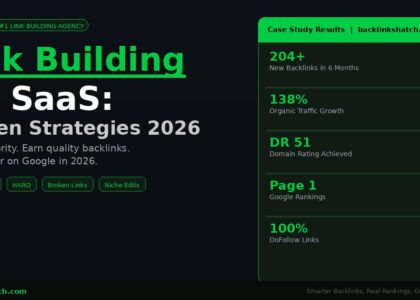
If your business operates in the SaaS space rather than local services, the same principles apply. Read this breakdown of link building strategies for SaaS companies to see how the tactics adapt across business models.
7. What to Avoid in 2026
Link Building Tactics That Trigger Google Penalties
Not all links help you rank. Some destroy your rankings and require months of recovery work. Google’s algorithms in 2026 are significantly better at detecting manipulative link patterns than they were even two years ago. Understanding what to avoid is as important as knowing what to do.
Private Blog Networks (PBNs): Google detects these at scale. A manual penalty wipes out months of SEO progress overnight. PBNs are networks of websites built specifically to sell links. They have no real audience and exist purely for link manipulation. Avoid them entirely.
Paying for links on link farms: Sites that sell hundreds of links for low prices have no real readership. The links carry no value and actively increase your spam score, making future legitimate links work less effectively.
Irrelevant directory submissions: Submitting your site to 500 random directories adds noise to your backlink profile. Focus exclusively on relevant, quality directories that your target audience actually uses.
Reciprocal link schemes: ‘I link to you, you link to me’ at scale is a manipulation tactic that Google’s algorithm identifies clearly. Occasional natural reciprocal links between genuine partners are fine. Systematic schemes are not.
The safest link building in 2026 is link building that earns trust from real websites through real content. If you are uncertain whether a tactic crosses the line, this comparison of white hat vs black hat link building covers every major tactic and where each one falls on the risk spectrum.
Anchor Text Mistakes That Flag Over-Optimization
Anchor text is the clickable text used in a hyperlink. It is one of the most important and most misused elements in link building. Getting your anchor text distribution wrong is one of the fastest ways to trigger a Google over-optimization penalty.
The problem most small businesses make is using their target keyword as the anchor text on every backlink they build. If 60% of your backlinks all use the same keyword phrase as anchor text, it looks unnatural. Real editorial links use varied, contextual anchor text. A pattern of identical anchors signals manipulation.
Here is a safe anchor text distribution to follow:
- 40% branded anchors (your business name or website name)
- 30% generic anchors (click here, learn more, visit this page, read more)
- 20% partial-match keyword anchors (phrases related to your keyword but not exact)
- 10% exact-match keyword anchors (your precise target keyword)
This distribution mirrors how natural editorial links look. It tells Google that your links were earned organically across different contexts rather than built with a specific keyword manipulation goal. Monitor your anchor text profile monthly using Ahrefs or SEMrush and adjust your outreach strategy if the distribution starts to skew.
Frequently Asked Questions
How many backlinks does a small business actually need to rank?
There is no fixed number. It depends on your competition. Run a search for your main keyword and check the backlink profiles of the top three results using Ahrefs or Moz. Match or slightly exceed their referring domain count with links of similar or better quality. In low-competition local markets, 30 to 50 strong backlinks from relevant sites often move you to page one.
Is guest posting still safe in 2026 after Google’s updates?
Yes, when done correctly. Google targets spammy, low-quality guest posts written purely for links with no value for readers. Guest posts on real websites, written for real audiences, with naturally placed links, remain safe and effective. Focus on sites with genuine readership, not sites built to sell links.
How long before link building shows results?
Most businesses see measurable movement in rankings between three and six months after starting a consistent campaign. Links take time to be crawled, indexed, and factored into Google’s algorithm. Consistency over time matters more than speed. Stopping and starting a campaign is the fastest way to slow your progress.
Should small businesses do link building themselves or hire a service?
Both work depending on your resources. Doing it yourself is slower but costs only time. Hiring a service is faster but requires a budget. If you have time and no budget, start with local citations, business partnerships, and HARO outreach yourself. If you want faster, more scalable results, a focused guest post campaign through a trusted agency delivers better long-term ROI than most paid advertising channels.
What is the best free link building strategy for a small business?
Local citations and HARO outreach cost nothing. Citations build your local SEO foundation fast. HARO earns editorial links from high-authority publications without any link exchange. Both require consistent time, not money. Start there before investing in paid link-building services.
What anchor text should I use for my backlinks?
Use a natural mix. Roughly 40% branded anchors, 30% generic anchors, 20% partial-match keyword anchors, and 10% exact-match keyword anchors. This distribution looks natural to Google and avoids over-optimization penalties that reverse your ranking gains.
Build Authority Consistently, and Your Rankings Follow
The businesses that win at SEO in 2026 are not the ones with the biggest budgets. They are the ones who apply the right link building strategies for small businesses consistently over time. Start with the tactics that match your current resources. Local citations and business partnerships cost nothing. Guest posting scales with your budget. Digital PR and linkable assets compound your authority for years.
Every backlink you earn from a relevant, trusted source is a vote of confidence that Google uses to rank your pages higher. The gap between you and your competitors narrows every month you stay consistent. Do not wait until your competitors build a backlink profile you cannot catch. Start now with the strategies in this guide. If you want expert support building high-quality backlinks through vetted guest post placements and white hat outreach, BacklinksHatch works with small businesses globally to deliver real rankings results. Visit BacklinksHatch.com to explore our guest post services, link-building packages, and get a free strategy consultation today.