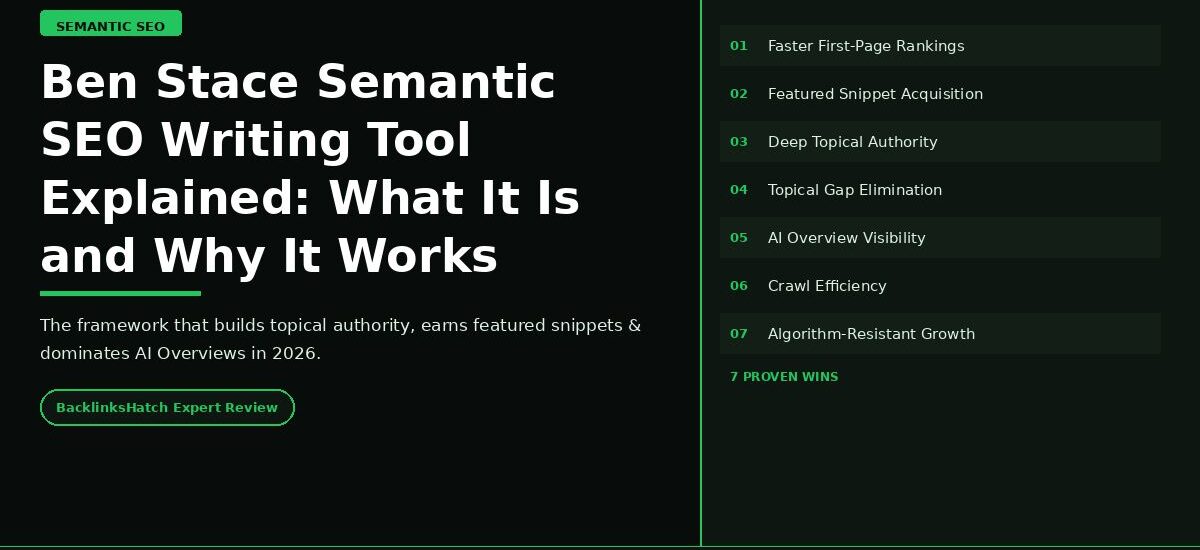
Introduction: Why Semantic SEO Now Determines Who Ranks
If your content is ranking on page two or three despite solid keyword research and decent backlinks, the problem is almost certainly semantic depth — and that’s exactly what the Ben Stace Semantic SEO Writing Tool is built to fix. Traditional SEO tools tell you what keywords to use. This tool tells you how to build content that search engines genuinely recognize as authoritative. Ben Stace developed this framework by studying how modern search algorithms — powered by BERT, MUM, and Google’s Gemini AI — actually evaluate content quality. The result is a structured writing system that maps entities, fills topical gaps, and builds the kind of depth that earns stable rankings, featured snippets, and AI Overview citations. At BacklinksHatch, we’ve seen semantic depth be the single biggest differentiator between pages that rank and pages that don’t. This article explains exactly what the tool is, how it works, and why it consistently outperforms traditional keyword-based SEO in 2026.
Table of Contents
What Is the Ben Stace Semantic SEO Writing Tool?
The ben stace semantic seo writing tool is a purpose-built content creation framework and software system designed to help writers and SEO professionals produce content that aligns precisely with how modern search engines understand language, topics, and entities. Unlike conventional keyword tools that simply calculate frequency, this tool maps the entire semantic landscape of a topic — identifying related concepts, supporting entities, and co-occurrence patterns that signal genuine expertise and topical depth to search algorithms.
The tool is built on three foundational principles: topical completeness, entity relationship mapping, and search intent alignment. Together, these principles ensure every article produced does not merely target a keyword — it authoritatively covers a subject in a way that earns long-term topical authority and sustained organic visibility.
What makes this distinction so important is the compounding effect. When a page achieves topical completeness, it does not just rank for one keyword — it captures hundreds of long-tail and related queries that keyword-focused content misses entirely. This is why users of the Ben Stace framework often see a sudden jump in impressions from Google Search Console that far exceeds what they targeted. The semantic approach creates a wide net that catches searchers at every stage of their journey around a topic.
Core Features and Capabilities of the Tool
Topic Cluster Mapping automatically identifies every subtopic, supporting question, and related concept that must be covered to achieve topical completeness. This removes the uncertainty from content planning and guarantees comprehensive coverage of every subject. Rather than relying on a writer’s intuition, the tool provides a data-driven map of the entire topic landscape.
LSI Keyword Generation identifies latent semantic indexing keywords — the specific terms and phrases that trained NLP models associate with genuine expertise on a given subject. These go far beyond simple synonyms: they are the vocabulary of authority that algorithms recognize as signals of deep subject knowledge. A page about “diabetes management” that never mentions “insulin resistance,” “blood glucose monitoring,” or “HbA1c levels” will not be evaluated as authoritative, regardless of how many times it uses the phrase “diabetes management.”
Entity Recognition identifies the people, organizations, places, and concepts that should be referenced in content to satisfy knowledge graph requirements. Including the right entities signals to search engines that your content exists within the correct semantic context for its target topic. Entities are the building blocks of how Google’s Knowledge Graph understands the world — and content that correctly places itself within those entity relationships earns a form of trust that keyword optimization simply cannot replicate.
Semantic Gap Analysis compares your existing content against top-ranking competitors to identify specific topical areas where your content underperforms. According to Google Search Central, content that comprehensively addresses a topic from multiple relevant angles is significantly more likely to surface in featured snippets, People Also Ask boxes, and AI Overviews.
Why the Tool Outperforms Traditional Keyword Research Methods
Traditional keyword research operates on a fundamentally outdated premise: find high-volume keywords and instruct writers to use them a defined number of times. Today’s search infrastructure — powered by BERT, MUM, and Google’s Gemini AI — evaluates content the way a human expert would, assessing genuine comprehension rather than keyword presence.
The semantic writing tool by Ben Stace is built for this new reality. Rather than asking ‘how many times should I use this keyword?’, it asks ‘what does truly authoritative content on this topic look like, and how do I build it?’ According to Ahrefs’ Semantic SEO Guide, modern search engines evaluate the entire semantic context of a page — not individual keywords in isolation. That is exactly the gap this tool fills.
Writers using the Ben Stace semantic brief begin with a complete roadmap. The result is not just better content — it is faster production of better content, which transforms the economics of organic content investment entirely.
Who Is Semantic SEO Expert Ben Stace?
Ben Stace is a globally recognized semantic SEO expert, digital marketing strategist, and content architecture specialist with over a decade of hands-on experience. His approach is rooted in information retrieval theory, computational linguistics, and knowledge graph optimization — the technical disciplines that underpin how modern search engines actually process and rank content.
What distinguishes Ben Stace from the broader SEO community is that he does not simply follow best practices — he derives them from first principles. By studying how search engines build and query their knowledge graphs, how NLP models assign meaning to text, and how information retrieval systems rank documents for relevance, he has developed a methodology that is aligned with where search is going — not where it has been.
His client roster spans global brands, enterprise publishers, and high-growth digital businesses across SaaS, healthcare, finance, e-commerce, and media. His track record includes documented improvements in organic search traffic, domain authority, featured snippet acquisitions, and revenue from organic channels.
How Does Ben Stace Do Semantic SEO?
Understanding Ben Stace’s process reveals why his methodology produces results that traditional SEO cannot match. His approach is systematic, analytical, and grounded in how search engines actually evaluate content at an algorithmic level.
The 5-Stage Semantic Content Framework Explained
At the core of Ben Stace’s methodology is the Semantic Content Framework — a five-stage process for creating content that achieves topical authority and dominates organic search results.
Stage 1 — Entity Identification: Every content project begins by identifying the primary entity and mapping it within the broader knowledge graph to understand its relationships with other entities, its defining attributes, and the co-occurring concepts that authoritative sources associate with it. This step transforms content planning from keyword-matching into a genuine semantic strategy.
Stage 2 — Topic Cluster Architecture: A comprehensive topic cluster architecture is built — a hierarchical map of all subtopics, supporting questions, and related concepts required for topical completeness. According to SEMrush’s Topic Cluster Guide, websites using a pillar-cluster model consistently outrank those with fragmented, isolated content pages.
Stage 3 — Semantic Brief Development: A detailed semantic content brief is produced, specifying exactly which entities, LSI keywords, NLP-optimized phrases, and subtopics must appear. Unlike a traditional keyword brief, a semantic brief provides a complete roadmap for producing content that satisfies search intent at every level of depth.
Stage 4 — Entity-Optimized Writing: The writing phase involves producing content that naturally incorporates all semantic elements from the brief. Co-occurring terms, contextual relationships, and supporting evidence are integrated in the way a true subject matter expert would naturally include them. Modern algorithms are sophisticated enough to distinguish genuinely helpful content from mechanically optimized text.
Stage 5 — Technical Semantic Optimization: The final stage addresses Schema.org structured data implementation, internal linking architecture design, and crawl optimization to ensure search engines can efficiently navigate and evaluate the entire content ecosystem.
Technology Stack: Tools and Techniques Ben Stace Uses
His toolkit includes TF-IDF analysis to identify terms that differentiate authoritative content; knowledge graph mapping tools for entity relationship visualization; search intent classification systems; and semantic gap analysis platforms for competitive benchmarking.
He also leverages anchor text optimization as a key part of his internal linking strategy — and understanding how link juice flows through your site is equally critical to ensuring the entire content cluster benefits from every new piece published.
Ben Stace Semantic SEO Case Studies
Case Study: Health & Wellness E-Commerce Brand — 312% Organic Traffic Growth
The Challenge
A mid-sized e-commerce brand in the health and wellness sector had been publishing content consistently for over two years and investing heavily in link building. Despite this, organic search traffic had plateaued, and rankings for core product-related keywords were declining. Google algorithm updates had eroded positions they had held for years, while competitors with smaller domain authority scores were overtaking them in the SERPs.
An initial semantic audit immediately identified the root cause: the brand had large content volume but near-zero topical authority. Articles existed in isolation, targeting individual keywords with no topic cluster architecture, no coherent entity strategy, and extensive topical gaps. This is one of the most common technical SEO mistakes that kill website traffic — investing in content volume without first building semantic depth.
The Strategy Applied
- Semantic Audit: Identified 47 distinct topical gaps using Ben Stace’s semantic gap analysis framework.
- Entity Mapping: Built a comprehensive knowledge graph of the brand’s core topic area, identifying 120+ related entities.
- Topic Cluster Architecture: Designed 8 pillar pages, each supported by 8 semantically related cluster articles.
- Content Optimization: Rewrote and expanded 35 existing articles for topical completeness.
- Schema Implementation: Applied Article, FAQ, BreadcrumbList, and Product schemas across all key pages.
- Internal Link Redesign: Rebuilt the internal linking architecture to create clear topical hierarchies.
Results After 6 Months
| Metric | Result (6 Months) |
| Organic Traffic | +312% year-over-year |
| Featured Snippets Acquired | 3 → 47 (+1,466%) |
| Average Keyword Ranking Position | Improved by 18 positions |
| Domain Authority | 28 → 41 |
| Revenue from Organic Search | +187% |
| Crawl Coverage | +34% more pages indexed |
Semantic SEO vs Traditional SEO: Full Comparison
The table below illustrates why the Ben Stace semantic approach produces superior results. Track your progress using the right tools — see our comparison of Ahrefs vs SEMrush for backlink analysis to choose the best platform for monitoring your semantic SEO growth.
| Dimension | Traditional SEO | Semantic SEO — Ben Stace |
| Primary Focus | Individual keyword targeting | Topic clusters & entity relationships |
| Content Strategy | Keyword density & word count | Topical completeness & semantic depth |
| Core Ranking Signals | Backlinks & on-page keywords | Topical authority & semantic relevance |
| Algorithm Resilience | Highly update-dependent | Algorithm-resistant by design |
| AI Search Optimization | Not addressed | Fully optimized for NLP & LLM systems |
| Featured Snippet Strategy | Inconsistent & ad hoc | Systematically targeted & scalable |
| Content Architecture | Pages in isolation | Interconnected topic cluster system |
| E-E-A-T Integration | Minimal focus | Core to every content piece |
| Time to Results | 4–8 months typical | 2–4 months with full implementation |
| Long-term Value | Declines with algorithm updates | Compounds as domain authority grows |
7 Proven Wins: What You Gain With the Ben Stace Semantic SEO Writing Tool
Win 1 — Significantly Faster First-Page Rankings
Content produced with the Ben Stace semantic framework consistently achieves Page 1 rankings faster than traditionally optimized content. By immediately satisfying topical completeness requirements, the content clears Google’s quality evaluation thresholds in its first indexing cycle rather than needing months of iterative optimization.
Users regularly report first-page rankings within 30 to 60 days on topics that typically require 4 to 6 months using conventional keyword approaches. The Google March 2026 Core Update reinforced exactly this principle — content with genuine topical depth and E-E-A-T signals maintained or improved its rankings, while thin, keyword-stuffed pages dropped significantly.
Win 2 — Systematic Featured Snippet and PAA Acquisition
The structured content approach naturally produces content that matches the exact formatting requirements of featured snippets, People Also Ask boxes, and Google AI Overviews. By writing content that delivers concise, direct answers to specific questions and then supports those answers with expert-level elaboration, users systematically acquire the SERP features that dominate click-through rates.
The case study documented growth from 3 to 47 featured snippets in six months — a result that would be virtually impossible through traditional keyword optimization alone. Featured snippets are increasingly the source material for voice search answers and AI Overview citations.
Win 3 — Deep, Durable, Compounding Topical Authority
By comprehensively covering all subtopics within a niche using the topic cluster architecture, users build the kind of entity-level authority that Google’s knowledge graph rewards with long-term, stable rankings. According to Moz’s Topical Authority Guide, topical authority is becoming the primary determinant of ranking stability — more durable than individual backlink counts in most niches.
Brands that commit fully to this approach typically report an inflection point around months 4 to 6 — the moment when Google’s systems recognize the domain as a genuine authority in the topic area, and begin preferentially surfacing its content for a broad range of related queries.
Win 4 — Elimination of Costly Topical Gaps
One of the most underappreciated ranking determinants is what your content does not cover. The semantic gap analysis component identifies missing elements before publication. Referring domains from authoritative sites will not save a page that has major topical gaps — both signals must work together for consistent rankings.
For existing content libraries, gap elimination is often the highest-ROI activity available. A well-written article that ranks in position 8 because of topical gaps can move to positions 1-3 with targeted gap-closing revisions — without requiring any additional link building or domain authority improvement.
Win 5 — Dominant Visibility Across AI Search Platforms
With Google AI Overviews, ChatGPT Search, Perplexity AI, and Microsoft Copilot all reshaping how users discover information, AI-readiness has become a critical dimension of modern SEO strategy. Semantically optimized content — with clear entity relationships, comprehensive topical coverage, and structured information architecture — is significantly more likely to be selected as a citation source by AI systems.
The Ben Stace methodology is explicitly designed to produce the type of structured, authoritative content that large language models and retrieval-augmented generation (RAG) systems prefer, ensuring strong visibility in both traditional and AI-driven search environments.
Win 6 — Optimized Crawl Efficiency and Index Coverage
The internal linking architecture that emerges from a properly implemented topic cluster strategy creates clear topical pathways that crawlers follow efficiently, resulting in better crawl budget utilization, higher index coverage, and cleaner PageRank distribution. Effective link-building strategies multiply this effect: external authority flows through your internal link structure.
You can also use niche edits to place contextual backlinks within existing authoritative pages for maximum crawl and authority benefit.
Win 7 — Algorithm-Resistant, Compounding Long-Term Returns
Because the methodology is built on principles that align with the fundamental direction of search engine development — rewarding genuine expertise and comprehensive coverage rather than exploiting algorithmic weaknesses — improvements made using the tool survive updates and compound over time. For teams actively building authority, link building outreach email templates provide a practical starting point for acquiring the external signals that reinforce your semantic SEO foundation.
Ben Stace Semantic SEO Consultancy Services
The writing tool is one component of a broader ecosystem of expertise available through Ben Stace Semantic SEO Consultancy Services. For businesses seeking comprehensive, end-to-end support in building organic search dominance, the consultancy offers a full range of strategic, analytical, and implementation services.
What Full-Service Consultancy Engagements Include
Every engagement begins with a comprehensive semantic SEO audit — a systematic evaluation of existing content for topical gaps, entity coverage, structural weaknesses, and technical SEO issues that are suppressing organic performance. The consultancy also delivers done-for-you content creation, team training workshops, Schema.org markup implementation, internal linking architecture redesign, and ongoing retainer arrangements.
Industries and Verticals Served
The consultancy has delivered documented results across SaaS, healthcare, finance, legal, e-commerce, media, and technology. In healthcare and finance — where Google’s YMYL guidelines demand exceptional expertise — the semantic approach has enabled top rankings despite intense algorithmic scrutiny.
Ben Stace Semantic SEO Consultant: What Sets Him Apart
In a crowded market of SEO professionals, semantic SEO consultant Ben Stace stands apart through genuine technical expertise, transparent methodology, and a proven track record of measurable results. His philosophy centers on knowledge transfer — building genuine semantic SEO capability within his clients’ teams rather than creating ongoing dependency.
For teams that want to validate tool effectiveness with data, using the best backlink analysis tools alongside the semantic framework allows you to track authority growth in parallel with topical depth improvements. Understanding the difference between URL Rating vs Page Authority helps you benchmark the right signals as your strategy gains momentum.
Semantic SEO Speaker Ben Stace: Insights from the Stage
As a semantic SEO speaker, Ben Stace brings the same depth of expertise and practical focus to conference stages that he brings to client engagements. He has delivered keynotes and workshops at leading digital marketing conferences, SEO summits, and content marketing events globally, consistently earning top-rated speaker status.
His speaking topics for 2026 include: The Architecture of Topical Authority, Entity-First Content Strategy, Optimizing for AI Overviews and Retrieval-Augmented Search, Knowledge Graph Positioning for Brands, and The Future of Semantic Search in an AI-Dominated Landscape.
Ben Stace Semantic SEO Testimonials
| “We tripled our organic traffic in under 5 months after implementing Ben’s semantic SEO framework. The structured approach to topical authority was a complete game-changer — we are now ranking for terms we had no expectation of competing for.”— Head of Growth, B2B SaaS Platform (Series B Funded) |
| “Ben Stace is genuinely in a different league when it comes to semantic SEO. His writing tool transformed how our entire content team approaches article creation. The ranking improvements are consistent and the methodology is now embedded in every piece we publish.”— Content Director, Digital Publishing Group |
| “As an SEO agency owner who has invested in dozens of tools and methodologies over 12 years, Ben Stace’s semantic SEO approach is the only one that consistently delivers top-3 rankings across multiple niches and survives major algorithm updates intact.”— Founder & CEO, SEO Agency |
| “We hired Ben Stace’s consultancy for a 6-month engagement and the results exceeded every target we had set. But what we valued most was how much our team learned. We now produce semantically optimized content independently.”— VP Marketing, E-Commerce Brand (Health & Wellness) |
| “The semantic gap analysis alone identified issues we had missed for over a year. Within three months of addressing those gaps, we moved 14 articles from page 2 and 3 into page 1 positions — without a single new backlink.”— SEO Manager, Enterprise Media Publisher |
Hire Ben Stace for Semantic SEO: The Full Engagement Process
If you are ready to hire Ben Stace for semantic SEO, here is exactly what the engagement process looks like — transparent, collaborative, and results-focused from the first conversation.
- Step 1 — Discovery Call (60 minutes): A structured consultation to understand your business objectives, current organic performance metrics, content challenges, competitive landscape, and budget parameters.
- Step 2 — Semantic Audit: A comprehensive analysis of your existing content, topical coverage, entity strategy, and technical SEO foundation. Produces a detailed report with prioritized recommendations and a clear improvement roadmap.
- Step 3 — Strategic Proposal: A detailed engagement proposal outlining the scope of work, recommended approach, projected outcomes, timeline, and investment required. All KPIs are agreed upon up front.
- Step 4 — Implementation: Delivery of the agreed scope — content strategy development, done-for-you content production, team training, technical implementation, or ongoing retainer support.
- Step 5 — Performance Review & Optimization: Regular reporting against agreed KPIs with data-driven strategy adjustments as the content ecosystem develops and rankings improve.
Conclusion: The Future of SEO Is Semantic
The Ben Stace Semantic SEO Writing Tool is not just another content optimization plugin — it’s a fundamentally different way of thinking about how content earns rankings. By focusing on topical authority, entity relationships, and semantic completeness rather than keyword frequency, it produces content that survives algorithm updates, earns featured snippets, and gets cited by AI Overview systems that are reshaping search in 2026. At BacklinksHatch, we pair this kind of semantic content strategy with high-authority link building to create compounding organic growth for our clients. If you’re serious about ranking consistently and sustainably, understanding and applying the Ben Stace Semantic SEO Writing Tool is one of the highest-leverage investments you can make in your content strategy right now.
Frequently Asked Questions (FAQs)
What exactly is the Ben Stace Semantic SEO Writing Tool, and how does it work?
The Ben Stace Semantic SEO Writing Tool is a content creation framework and system that maps the semantic landscape of a topic — identifying related entities, subtopics, LSI keywords, and co-occurrence patterns — and generates a structured content brief that writers follow to ensure comprehensive topical coverage. The result is content that satisfies topical authority requirements and search intent at every level.
How is semantic SEO different from traditional keyword SEO?
Traditional SEO focuses on keyword frequency. Semantic SEO, as Ben Stace practices it, focuses on topical completeness — covering all the entities, subtopics, and related concepts that constitute genuine expertise on a subject. The strategic goal shifts from ranking for a single keyword to establishing domain-level authority over an entire topic area.
Who should use the Ben Stace Semantic SEO Writing Tool?
The tool is ideal for content writers, SEO consultants, digital marketing managers, content strategists, and business owners who want to move beyond keyword optimization and build genuine topical authority. It is most valuable for anyone creating content in competitive niches.
How quickly can I expect to see results from implementing this methodology?
Many individual articles achieve first-page rankings within 30 to 60 days, compared to the 4 to 6 months typically required with traditional keyword optimization. The full methodology delivered a 312% organic traffic increase within 6 months in the documented case study.
Does Ben Stace offer training for content teams?
Yes, Ben Stace and his team offer structured training workshops, team coaching programs, and group training sessions tailored to each client’s industry, existing skill level, and content objectives.
Is the tool suitable for writers without a technical SEO background?
Absolutely. While the underlying methodology involves sophisticated semantic analysis, the output — the content brief and framework — is designed to be immediately actionable by writers without technical SEO knowledge.
How does the Ben Stace approach optimize content for AI search platforms?
The methodology produces content with the structural characteristics that AI search systems — including Google AI Overviews, ChatGPT Search, and Perplexity AI — prefer when selecting citation sources: clear entity definitions, comprehensive topical coverage, structured Q&A formatting, and explicit concept relationships.
What does it cost to hire Ben Stace for a semantic SEO project?
Pricing depends on the scope, duration, and complexity of the engagement. Investment ranges are discussed during the initial discovery call, where the scope of work and projected outcomes are defined. All proposals include clear KPIs so ROI can be tracked transparently.