Every brand wants more traffic, more leads, and more sales. But most brands fail because they publish content without a plan. A solid content marketing strategy 2026 separates growing brands from stagnant ones.
In 2026, search engines reward depth, trust, and relevance. AI tools flood the internet with thin content every day. Your only edge is a strategy built on expertise, data, and real audience needs.
This article gives you 5 battle-tested plans. Each one is built for results. Before diving in, make sure you understand the basics by reading our guide on keyword research for beginners, so you build on a strong foundation.
1. Build a Topical Authority Framework
Google in 2026 ranks websites that own a topic, not just target a keyword. Topical authority means you cover every angle of your niche deeply and consistently.
How to Build Topic Clusters That Rank
Start with one pillar page. This is a long-form page targeting your broadest keyword. Around it, build cluster content targeting related subtopics. Every cluster page links back to the pillar. Every pillar links out to clusters.
This structure tells Google your site understands the full topic. It builds semantic relevance across your entire domain. Internal linking is the glue that holds this system together. Our guide on link building strategies for small businesses shows how to strengthen those connections from the outside, too.
Here is how to execute it:
- Pick your core topic (example: content marketing)
- List 15 to 20 subtopics that your audience searches for
- Write one pillar page (3,000 plus words)
- Write cluster posts for each subtopic (1,000 to 1,500 words each)
- Interlink every page with descriptive anchor text
Brands building topic clusters see 30 to 40 percent more organic traffic within 6 months. HubSpot switched to topic clusters in 2017 and doubled its organic search traffic in one year. The model still works in 2026.
Tools and Metrics to Track Topical Authority
Use Ahrefs or Semrush to measure topical authority scores. Track keyword rankings across your entire cluster, not just one page. Monitor internal link equity flow using tools like Screaming Frog.
Key metrics to watch:
- Domain Rating (DR) growth month over month
- Organic impressions across topic cluster pages
- Click-through rate (CTR) from search results
- Average position for cluster keywords
- Crawl depth of cluster pages via Google Search Console
Set a 90-day review cycle. If cluster pages stagnate, update them with fresher data, stronger internal links, or expanded sections. Google rewards content that improves over time. Also, check that Googlebot reaches all your pages by reviewing our guide on how to fix website crawl errors.
2. Content Marketing Strategy 2026: Lead With Search Intent
Most brands write what they want to say. Winning brands write what their audience needs to hear. Search intent is the real reason behind every Google query.
The 4 Intent Types You Must Serve
Every keyword falls into one of four intent categories. Match your content format to the intent, and your rankings improve fast.
| Intent Type | What the User Wants | Best Content Format | Ranking Priority |
| Informational | Learn something | Blog posts, guides, FAQs | High |
| Navigational | Find a specific site | Brand pages, landing pages | Medium |
| Commercial | Compare options | Reviews, comparisons, listicles | Very High |
| Transactional | Buy or sign up | Product pages, service pages | Highest |
Mismatching intent is one of the biggest ranking killers. A product page targeting an informational keyword seldom ranks on page one. Write for what the user actually wants at that moment.
NLP keywords like “how to,” “best way to,” “what is,” and “step by step” signal informational intent. Use them in your headings and opening paragraphs to align with how Google reads your content. Learning to write optimized titles is a quick win, so check out our post on title tag optimization.
How to Map Keywords to Intent at Scale
Pull your keyword list from Google Search Console or Ahrefs Keywords Explorer. Sort by search volume. Then classify each keyword by intent manually or use AI tools to speed up the process.
Build a content calendar based on intent clusters. Publish informational content first to build trust. Then publish commercial content to convert trust into leads.
Steps to execute intent mapping:
- Export 100 to 200 target keywords
- Tag each as informational, commercial, navigational, or transactional
- Group keywords by intent type
- Assign content formats to each group
- Schedule content in order of funnel stage (awareness first, conversion last)
Brands aligning content to search intent see higher dwell time, lower bounce rates, and stronger conversion rates across every page.
3. Use Data-Driven Content to Build Trust and Expertise
Google’s E-E-A-T framework (Experience, Expertise, Authoritativeness, Trustworthiness) directly influences rankings. In 2026, thin opinion pieces do not rank. Data-backed, expert-led content does.
Authority reference: Google’s Search Quality Evaluator Guidelines detail exactly how E-E-A-T is assessed by human raters.
How to Source Original Data for Your Content
You do not need a research budget to produce original data. Here are three methods any brand uses:
Run surveys. Use tools like Typeform or Google Forms to survey your audience. Even 50 to 100 responses give you publishable data points. Package findings into a report or blog post.
Analyze your own platform data. If you run an agency or SaaS tool, your internal data is a gold mine. Anonymize it and publish insights. Backlinko does this with SEO studies that earn thousands of backlinks every year.
Aggregate public datasets. Use Statista, Google Trends, or government databases. Combine multiple sources to build a unique angle. Always cite your sources.
Original data builds backlink equity, brand authority, and social proof at the same time. One strong data study generates more backlinks than 20 standard blog posts. Pair this with a solid off-page SEO approach for maximum impact.
Case Study: How Semrush Builds Authority With Data Content
Semrush publishes an annual “State of Content Marketing” report. The 2023 edition attracted over 3,200 referring domains. The 2024 edition topped that.
Here is what they do right:
- Survey thousands of marketers globally
- Package findings in a visually rich PDF and blog post
- Promote the report through email, social, and PR outreach
- Update it annually to maintain freshness and backlink flow
You apply the same model at a smaller scale. Survey 100 customers. Publish a “State of [Your Niche] 2026” post. Pitch it to industry blogs and newsletters. Even a modest study earns 20 to 50 backlinks when the data is specific and relevant.
Data content is the fastest way to demonstrate subject matter expertise and earn the trust signals Google looks for in 2026.
4. Optimize for AI-Powered Search and Voice Queries
Search in 2026 is not just text boxes and blue links. AI Overviews now answer queries directly on the results page. Voice search accounts for a growing share of queries on mobile and smart devices.
For deeper context on how Google evaluates structured content, read the Google Search Central documentation on structured data and page quality.
Writing Content That AI Overviews Feature
Google’s AI Overview pulls answers from content that is clear, structured, and authoritative. To get featured, your content must answer questions directly and fast.
Follow these principles:
- Place the direct answer within the first 100 words of each section
- Use question-based H2 and H3 headings (What is, How to, Why does)
- Write in short sentences (15 to 20 words average)
- Use numbered lists and bullet points for process-based answers
- Add a dedicated FAQ section to every article
Structured content signals to AI systems that your page contains a clear, extractable answer. Pages with schema markup (FAQ schema, HowTo schema, Article schema) get featured more often in AI-generated results. Your meta descriptions also play a role in how AI systems preview your content.
Optimizing for Voice Search in 2026
Voice queries are longer and more conversational than text queries. “Best content marketing strategy” becomes “What is the best content marketing strategy for a small business in 2026?”
To rank for voice:
- Target long-tail keywords with 5 or more words
- Write FAQ sections using natural spoken language
- Answer the who, what, where, when, why, and how of your topic
- Keep answers under 50 words for voice snippet eligibility
- Optimize page speed; voice results load fast pages first
Local businesses benefit most from voice search optimization. Pair voice SEO with local content marketing to drive foot traffic and calls from nearby customers.
5. Repurpose Content Across Every Channel Systematically
Most brands create content once and publish it once. Top brands extract maximum value from every piece by repurposing it across multiple formats and platforms.
The Content Repurposing System That Works
Start with one high-quality pillar piece of content. A 2,000-word blog post becomes the source material for everything else.
From one blog post, you produce:
- 5 to 7 short-form social media posts (LinkedIn, X, Instagram)
- 1 email newsletter edition
- 1 short-form video script (YouTube Shorts, Reels, TikTok)
- 1 infographic summarizing key points
- 1 podcast episode outline or talking points document
- 3 to 5 quote graphics for social sharing
This system multiplies your content output without multiplying your production time. One blog post becomes 12 to 15 pieces of content across channels.
Buffer built their entire brand on repurposed content early on. They turned blog posts into Twitter threads, email content, and social updates. Their blog grew to 1.5 million monthly readers using this model.
How to Prioritize Which Content to Repurpose
Not every post deserves repurposing. Focus your repurposing effort on content that already performs.
Check Google Search Console for posts with:
- High impressions but low CTR (optimize title and repurpose)
- Strong traffic but low time on page (improve and repurpose)
- High engagement but few backlinks (promote through repurposed formats)
Repurposing high-performing content multiplies its reach without starting from scratch. It also strengthens content distribution, brand recall, and multi-channel authority at the same time.
A complete content marketing strategy 2026 without repurposing wastes 80 percent of your production effort. Build the repurposing habit into your editorial workflow from day one. If you need quality backlinks pointing to your repurposed content, explore our guest post services to amplify reach.
Frequently Asked Questions
What makes a content marketing strategy work in 2026?
A strategy works when it aligns with search intent, builds topical authority, and publishes content backed by real data. Consistency matters more than volume. Publish less but publish better.
How many blog posts do I need to see results?
There is no fixed number. Focus on covering your topic cluster completely. A site with 30 deeply researched posts outperforms a site with 300 thin ones every time.
Does AI-generated content hurt SEO in 2026?
AI content does not automatically hurt rankings. Thin, unedited, low-value AI content does. Use AI as a drafting tool. Add your expertise, data, and real-world examples before publishing.
How do I measure the content marketing strategy 2026 performance?
Track organic traffic, keyword rankings, backlinks earned, leads generated, and conversion rates by content type. Review monthly and adjust your strategy based on what the data shows.
What is the fastest way to build topical authority?
Publish a pillar page first. Then build cluster content around it consistently. Interlink every piece. Update older posts regularly. Authority builds in 3 to 6 months with consistent effort.
How often should I publish new content?
Quality beats frequency every time. One well-researched post per week beats five thin posts. Match your publishing pace to the quality standard you set in your first few posts.
Is social media part of a content marketing strategy?
Yes. Social platforms are content distribution channels. They amplify your blog content, build brand awareness, and drive referral traffic back to your website. Treat social as distribution, not separate content.
Conclusion
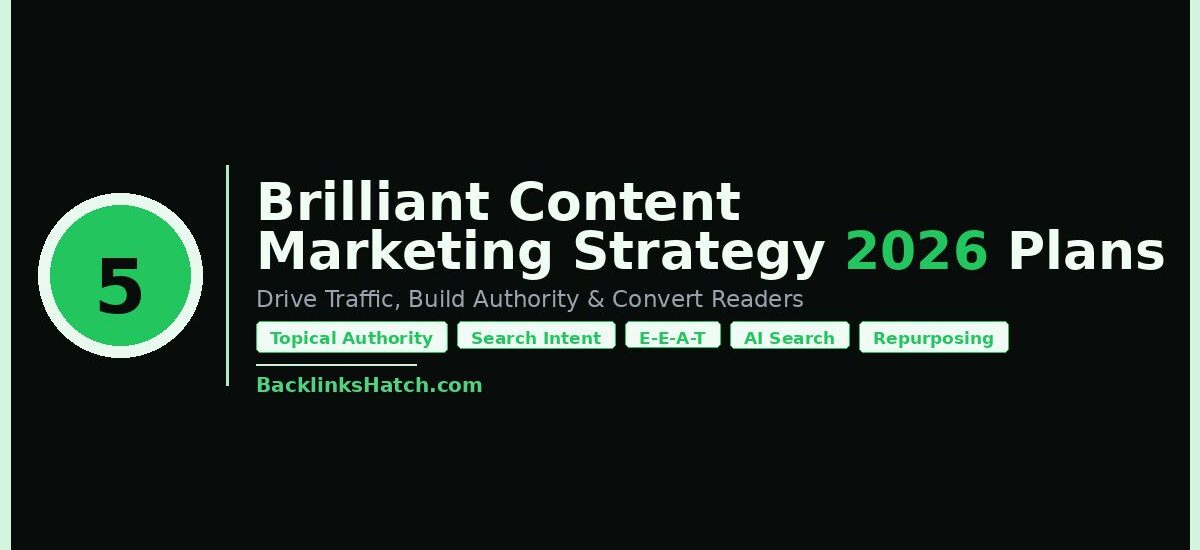
A strong content marketing strategy in 2026 is not about publishing more. It is about publishing smarter. Build topical authority. Match every piece to search intent. Back your claims with data. Optimize for AI search and voice queries. Repurpose your best content across every channel.
These five plans work because they are built on how search engines and real audiences behave today. Start with one plan. Execute it completely. Then add the next.
The brands winning in 2026 are not the ones with the biggest budgets. They are the ones with the clearest strategy and the discipline to follow it.
Need high-authority backlinks to power your content strategy? See how BacklinksHatch guest post services help you earn editorial links that move rankings.