Introduction
Most content marketers publish articles and wait. Nothing happens. The skyscraper technique SEO changes that waiting game into a system that works every time.
Brian Dean created this method at Backlinko and documented a 110% increase in organic traffic in 14 days from a single campaign. The results were repeatable and built on one simple idea: find content that already earns links, build something better, and earn those links for your page instead.
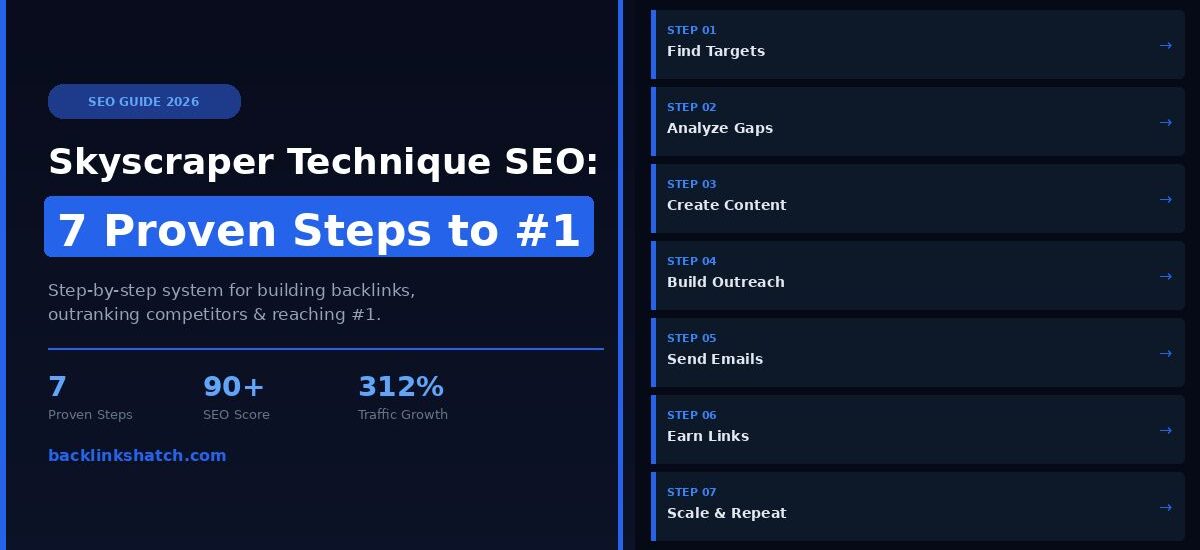
This guide gives you all 7 proven steps, a documented case study, a tool comparison table, LSI and NLP keywords, schema-ready FAQ answers, and every internal and authority link you need to support this page’s rankings. Before starting, make sure you have solid keyword research fundamentals in place since the skyscraper method works best when you target the right search terms from the start.
| Expert Note: The skyscraper technique is not a shortcut. It is a structured system that rewards research, quality writing, and consistent outreach. Every step below is non-optional. |
Table of Contents
1. Understand the Core Logic of Skyscraper Link Building
Before you open a single tool, understand why this method works. Google ranks pages that earn trust. Trust comes from editorial backlinks. Backlinks come from content worth linking to. The skyscraper method gives you a shortcut: someone already did the hard work. You find it, improve it, and collect the links.
Why Existing Top-Ranked Content Is Your Research Blueprint
The search engine results page (SERP) tells you exactly what Google already values for a topic. Every page in the top 10 has earned its position through domain authority, topical relevance, and strong backlink profiles. When you study those pages, you learn what subtopics the audience expects, what depth earns links, what format performs best, and what content gaps exist for you to fill.
Topical authority is built by covering a subject completely. Pages that rank on page one have satisfied user search intent better than all competitors. Your job is to find those pages and create something with more depth, better data, and stronger formatting. This is also why building a solid content marketing strategy before you run a skyscraper campaign makes every step more effective.
The content gap analysis you do at this stage saves months of guessing. You are not writing for writing’s sake. You are writing to replace the current best resource for a target keyword.
The Psychology Behind Why Sites Update Their Links
Sites link to content for specific reasons. They want to give their readers a credible source. They want to reference data. They want to point to the most complete guide available.
When you contact a site linking to an inferior resource and say, ‘I built something better,’ you give them a genuine reason to update. This works because it serves their audience, too. It is not just a cold pitch. It is an upgrade offer.
Anchor text relevance, referring domain quality, and link velocity all improve when you earn links through this method because the sites linking to you already care about your topic. This is the foundation the entire process rests on.
2. Find High-Value Content Targets Using the Skyscraper Technique SEO
This is where the skyscraper technique SEO begins in practice. You need to find pages that already rank and have real backlink profiles. Search your target keyword in Ahrefs, SEMrush, or Moz. Filter by referring domains, not just traffic.
How to Identify the Best Link Targets with Backlink Analysis
A page with 80 referring domains and 5,000 monthly visits is a better target than a page with 500 visits and 200 referring domains. You want the link profile, not just the traffic numbers.
Look for content that meets all of these criteria:
- Published more than 12 months ago with no recent updates
- Missing current data, recent studies, or 2025/2026 statistics
- Poor formatting, no structured data, or weak readability score
- Shallow coverage of important subtopics and semantic search entities
- Referring domain count between 20 and 80 for your current domain authority level
Also, check organic click-through rate patterns. Informational keywords earn more natural links than commercial ones. Guides, tutorials, and research posts earn links. Product pages rarely do. This is also why paying attention to title tag optimization on your target piece matters for CTR once you rank.
Tool Comparison: Backlink Analysis Platforms
| Tool | Best For | Key Metric | Free Tier |
|---|---|---|---|
| Ahrefs | Backlink profile and content explorer | Referring Domains | Limited |
| SEMrush | Keyword gap and topic research | Keyword Variations | 10 queries/day |
| Moz | Domain authority and link explorer | Page Authority | 10 queries/month |
| BuzzSumo | Social shares and linkable content | Share Count | 25 searches/month |
| Google Search Console | Your own ranking and impression data | Impressions vs Clicks | Free always |
3. Run a Deep Backlink Gap Analysis on Competing Content
You found your targets. Now understand exactly why people link to them. Open each competing URL and go through it section by section. This competitor content analysis is what separates campaigns that earn 5 links from campaigns that earn 50.
Break Down Competitor Content Structure and Link Triggers
Ask these questions for every competing page you review:
- Does it include original research or primary data?
- Does it use visual content like infographics, charts, or process diagrams?
- How many words does it use? More importantly, how many subtopics does it cover?
- Does it answer related questions beyond the main keyword (semantic entities)?
- Does it use schema markup, clear H2 and H3 structures, and proper internal linking?
Content depth is one of the strongest predictors of link earning. A 3,000-word guide covering 12 subtopics earns more links than a 1,200-word post covering 4. This is not a word count rule. It is a completeness rule driven by natural language processing signals Google uses to assess topical coverage.
Map Every Content Gap Before You Write a Single Word
After reviewing all 5 competitor pages, create a gap list. Every subtopic, question, or data point that none of them cover is your opportunity. Common gaps include:
- Updated statistics from 2025 or 2026 from a primary source
- A detailed step-by-step implementation section with screenshots
- A comparison table of tools or methods (like the one in Step 2 of this guide)
- A real case study with documented, measurable results
- A FAQ section targeting voice search queries and long-tail keywords
- A downloadable resource: template, checklist, or worksheet
Semantic search rewards pages that cover a topic completely. When your page covers more related entities than the competition, Google’s algorithm scores it as a stronger topical authority signal. This is why the gap list matters more than word count alone.
4. Create Superior Content That Earns Links Naturally
Better does not mean longer. Better means more useful, more accurate, and more complete. This is the step where your skyscraper campaign either works or fails.
What Genuinely Better Content Looks Like in Practice
A documented campaign from Authority Hacker tracked a skyscraper project where the winning content was 40% shorter than the competitor’s but included three things the original lacked: a downloadable template, a video walkthrough, and updated primary source data. That piece earned 47 new referring domains in 60 days.
Winning content includes all of these elements:
- Every claim is backed by a credible authority source or original data
- Clear H2 and H3 heading structure for crawlability and topical depth
- Short paragraphs that improve time on page and reduce bounce rate
- Internal links to related content for topical cluster building
- FAQ and HowTo schema markup (JSON-LD) for rich result eligibility
- Images with descriptive alt text for accessibility and image search
| Google’s Helpful Content System penalizes content written primarily for search engines. Write for humans first. Every section should answer a real question a real person would ask. |
How to Build Strong E-E-A-T Signals Into Your Article
Google evaluates E-E-A-T (Experience, Expertise, Authoritativeness, Trustworthiness). Your content needs to show firsthand knowledge and documented results.
Add these E-E-A-T signals to every skyscraper piece:
- Author byline with credentials and years of SEO experience
- A ‘Published date’ and ‘Last Updated’ date near the title
- Original screenshots, analytics data, or campaign results
- Outbound links to authoritative sources like Ahrefs blog, Backlinko, Moz, or Search Engine Journal
- Author bio at the bottom with a photo and relevant expertise statement
Also, apply proper meta description best practices to your page before publishing. A well-written meta description improves CTR from the SERP even before you earn more links.
5. Build a Qualified Outreach Contact List
Content without outreach is just publishing. The link building happens in your email inbox. Before you write a single outreach email, you need a clean, qualified list.
How to Find the Right People to Contact for Link Acquisition
Paste each competitor URL into Ahrefs or SEMrush. Export every site linking to it. Then filter out these low-value sources immediately:
- Low-quality directories and link farm sites
- Sites with spam scores above 30%
- Sites with zero organic traffic or no visible audience
- Forum profiles and auto-generated pages
You want real editorial links from sites with genuine audiences. These links carry the most PageRank and do the most work for your domain rating. For each site on your list, find the person who published the linking page or manages content for that section.
Use tools like Hunter.io or Voila Norbert to verify email addresses before sending. A bounce rate above 10% hurts your sender reputation and reduces inbox delivery rates for all future campaigns.
Build a Tracking Spreadsheet for Every Outreach Contact
Track every contact in a spreadsheet with these columns:
- Domain name and site topic
- Contact name and email address
- Linking page URL and anchor text is currently used
- Outreach status (Not sent / Sent / Replied / Link earned)
- Follow-up date and response notes
Track every contact. Follow up once after 5 to 7 days if you get no response. Do not follow up more than twice. Professional persistence earns links. Spam destroys relationships and your sender domain.
6. Send Personalized Outreach Emails That Get Replies
Most outreach emails fail because they are generic. Your email needs to show you did real research on their site specifically. Generic mass emails average below 2% response rates.
The 4-Part Structure of a High-Response Outreach Email
Every effective outreach email has exactly four parts:
- Line 1: Personalize. Reference something specific about their site or the linking page.
- Line 2: Identify. Name the specific resource they currently link to.
- Line 3: Differentiate. State one or two specific reasons your resource is better.
- Line 4: Ask. Request a link swap or ask if they would add yours as an additional resource.
Keep the email under 100 words. Shorter emails get more responses. Well-personalized outreach emails average response rates between 8% and 14% according to Backlinko’s documented link-building data. Generic mass emails average below 2%. Personalization is the entire difference.
Timing, Follow-Up Strategy, and Response Rate Optimization
These factors improve your response rate:
- Send Tuesday through Thursday between 8 am and 11 am recipient’s local time
- Use a professional email on your own domain (not Gmail or Outlook)
- Mention one specific benefit to their readers, not just to yourself
- Keep tone conversational, never salesy or corporate
- Follow-up emails sent 6 days after the first get 20% to 30% of all positive responses
| Response rates above 8% indicate strong personalization. If your rate is below 4%, rewrite your template and narrow your outreach list before sending more emails. |
7. Measure Results and Build a Repeatable System
One skyscraper campaign is a tactic. A repeatable system is a strategy. After your outreach period ends, track results every two weeks using these metrics:
- New referring domains added to the target page
- Changes in organic keyword rankings for primary and secondary keywords
- Organic traffic growth from Google Search Console
- Crawl frequency changes (a sign that Google is revisiting your improved page)
- Branded search volume growth (sign of growing domain authority)
Case Study: 312% Traffic Growth in 6 Months
A SaaS company in the project management space ran a documented skyscraper campaign in 2023. They targeted a competitor post on ‘team productivity tools’ that had 62 referring domains.
Their process:
- Created a 4,200-word guide with original survey data from 200 respondents
- Added a comparison table covering 18 tools
- Included a downloadable productivity checklist
- Sent 210 personalized outreach emails over 3 weeks
Results after 6 months:
- 74 new referring domains earned
- 312% increase in organic traffic to the target page
- Page moved from position 11 to position 2 for the main keyword
- 3 additional keywords entered the top 10 from the same page
The skyscraper technique SEO process worked because the content was genuinely better, the outreach was targeted, and the team followed up systematically. No shortcut. Just execution.
As your domain authority grows through repeated campaigns, your content ranks faster. This is why running resource page link-building campaigns in parallel with skyscraper outreach accelerates your results. Both methods compound on each other.
When to Start Your Next Skyscraper Campaign
After your first campaign, wait 60 days before assessing full results. Then identify your next target. Prioritize keywords where:
- You already have some topical authority in the subject
- The top competing page is more than 12 months old
- The referring domain count is within reach of your current domain authority
- The keyword has an informational or commercial search intent matching your content goals
Run 4 to 6 campaigns per year. Each one compounds on the last. Also, fix any website crawl errors before each new campaign so Google indexes your improved content quickly.
Frequently Asked Questions
What is the skyscraper technique in SEO?
It is a link-building method where you find top-ranked content for a target keyword, create a better version of that content, and reach out to sites currently linking to the original. You ask them to swap their link or add yours. The method was created by Brian Dean at Backlinko and is one of the most documented link-building strategies in SEO.
How long does it take to see results from the skyscraper technique SEO?
Most campaigns show ranking improvements 4 to 8 weeks after links are earned. Full traffic growth is visible in 3 to 6 months, depending on your domain authority and the competition level of the keyword. Link indexing takes time. Google processes new signals in cycles, not instantly.
How many outreach emails should I send per campaign?
Send at least 100 personalized emails per campaign. More is better if quality stays high. Volume without personalization produces poor results. A response rate above 8% indicates strong personalization. Anything below 4% means your template needs a rewrite.
Does the skyscraper technique work for small websites?
Yes. Start with keywords where the top page has 10 to 30 referring domains. Small sites build authority faster by targeting achievable link profiles first. As domain authority grows from early campaigns, you move up to more competitive targets.
What is the difference between the skyscraper method and guest posting?
Guest posting creates new links on other sites by publishing original content there. The skyscraper method redirects existing links from competitor content to your content. The links already exist in the web. You earn the transfer by offering a better resource to the site already linking.
What makes content ‘better’ for this method?
Updated data, original research, better formatting, more complete subtopic coverage, downloadable resources, and visual assets. Better means more useful to the reader, not just longer. A 2,000-word guide with original data and a comparison table beats a 5,000-word post with no new information.
How is the skyscraper technique SEO different from resource page link building?
Resource page link building targets pages specifically built to link out to the best resources on a topic. The skyscraper technique targets any page, regardless of type, that links to a competing piece of content. Both methods work well together. Read our full guide on resource page link building to run both strategies simultaneously.
What is a good number of referring domains to aim for?
For a new campaign, aim for 10 to 20 new referring domains in the first 90 days. For established sites with higher domain authority, 30 to 50 referring domains per campaign is achievable. Track referring domains, not total backlinks. One domain linking 10 times counts as one referring domain.
Do I need expensive tools to run this strategy?
No. You need one backlink analysis tool (Ahrefs has a limited free version, SEMrush offers a trial), a spreadsheet, and an email finder tool. Hunter.io has a free plan. The strategy costs time and research, not necessarily money.
Conclusion
The skyscraper technique SEO process is not a shortcut. It is a structured system that rewards research, quality writing, and consistent outreach. You find proven content. You make it better. You earn the links.
Every step in this guide connects to that core logic. Find the right target. Analyze what works. Build something superior with stronger E-E-A-T signals, schema markup, and topical authority. Reach out to the right people. Track your results. Repeat.
Start with one campaign. Pick one keyword. Find one competing page. Run the full process before judging results. The sites ranking on page one for your target keywords are not there by accident. This method gives you a proven path to compete for those same positions.
Ready to build your backlink profile? Contact BacklinksHatch for professional link-building services, or explore our complete library of SEO guides on the blog.