Google rewrites 70% of meta descriptions. That single stat tells you two things. First, most website owners write poor descriptions. Second, when you write them correctly, you gain a real edge over competitors. Following proven meta description best practices is one of the highest-return, lowest-effort tasks in your entire on-page SEO strategy.
This guide gives you a complete, practical framework. You will learn the exact rules, character limits, writing formulas, and advanced tactics that SEO professionals use to increase click-through rate (CTR) without changing a single ranking. Every section includes actionable steps you can apply today.
Table of Contents
1. What Is a Meta Description and Why Does It Matter
A meta description is an HTML meta tag that provides a summary of a webpage. Search engines display it below the page title in search engine results pages (SERPs). It sits between your title tag and the destination URL in the search snippet.
Google confirmed that meta descriptions are not a direct ranking factor. But they directly influence CTR. Higher CTR sends positive user engagement signals to Google, which supports your rankings indirectly over time.
When you skip writing one, Google pulls random text from your page body. That text rarely functions as an effective summary. You lose complete control over your first impression in the SERP.
How Search Engines Read and Display Meta Descriptions
Search engines scan your meta description for semantic relevance to the user’s query. When your description contains terms that match the search query, Google bolds those words in the results. Bold text draws the eye. It signals to the user that your page directly answers their question.
According to a study by Portent, Google rewrites meta descriptions in approximately 70% of cases. The rewrite happens most often when your description does not closely match the search intent of the query. This is why writing accurate, query-aware descriptions reduces the chance of an automatic rewrite.
The Open Graph protocol also reads your meta description when no dedicated og: description tag is set. This means your description appears as the preview text when someone shares your page on Facebook, LinkedIn, or WhatsApp. One well-written description serves both organic search and social media visibility at the same time.
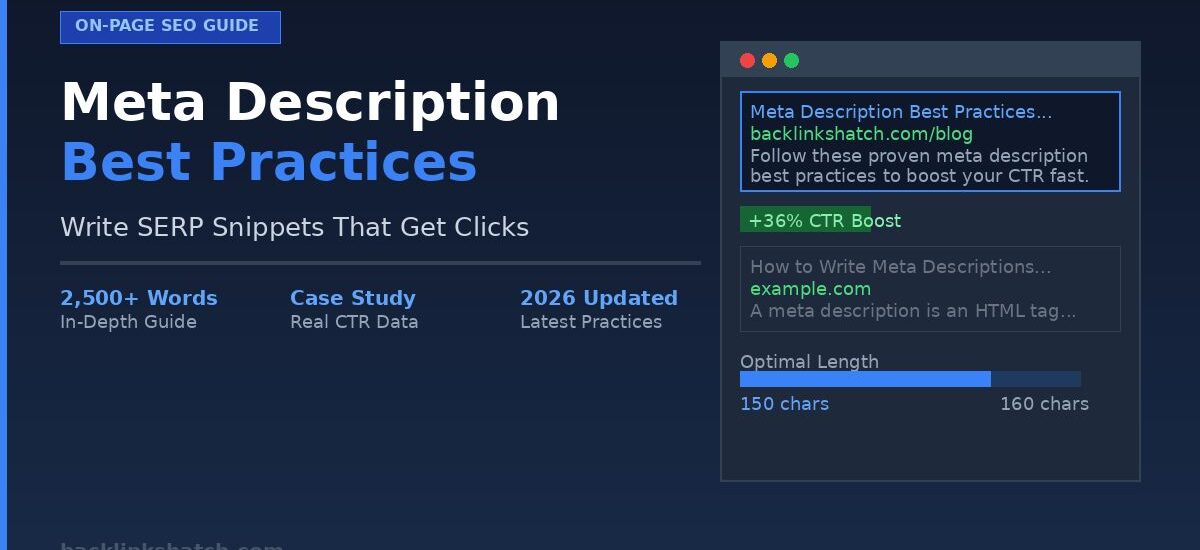
Mobile search results truncate descriptions earlier than desktop. On desktop, Google shows up to 160 characters. On mobile, the limit drops to around 120 characters. Front-loading your most important information ensures the message lands even on smaller screens.
The Business Value of Getting Meta Descriptions Right
Rankings drive impressions. Meta descriptions drive clicks. A page that ranks number three with a compelling description often outperforms a page that ranks number one with a weak description. This means your SERP snippet quality has a direct impact on traffic volume, independent of your ranking position.
A higher CTR from better descriptions brings more qualified visitors to your page. These visitors arrived because your description accurately matched their expectations. They are less likely to bounce immediately. Lower bounce rate and longer dwell time are positive behavioral signals that support long-term ranking stability.
For e-commerce pages, strong meta descriptions that include pricing, free shipping, or return policy details pre-qualify buyers before they click. This increases the conversion rate in addition to the click rate. The description becomes part of your sales funnel, not just an SEO detail.
For local businesses, including your city, service area, or a trust signal like years of experience in the description, gives local users confidence before they visit your page. Related reading: Title Tag Optimization: 7 Rules That Boost Click-Through Rate for how your title and description work together in the SERP.
2. Meta Description Best Practices You Must Follow in 2026
These are the core meta description best practices that every SEO professional applies consistently. Use these rules on every page you publish or update.
Keep Length Between 150 and 160 Characters
Google truncates meta descriptions that exceed 160 characters on desktop and around 120 characters on mobile. A truncated description ends mid-sentence with an ellipsis. It looks incomplete and often loses the call to action.
Write your most important information in the first 100 characters. Your primary keyword and your core value proposition belong at the start, not the end. Tools like Yoast SEO, Rank Math, and Screaming Frog display real-time character counts so you never go over the limit.
A 125-character description that is sharp and specific outperforms a padded 160-character description every time. The goal is not to fill the character limit. The goal is to communicate maximum value in minimum space. Every word must earn its place.
Run a regular audit using Google Search Console to identify pages where descriptions are too long, too short, or missing. Filter by impressions to prioritize your highest-traffic pages first. Fixing length issues on your top 20 pages often produces the fastest CTR improvement.
Match Search Intent in Every Description
Search intent is the reason behind a query. It falls into four main types: informational (how does X work), navigational (go to website X), commercial (best options for X), and transactional (buy X now). Your meta description must match the intent type of your target keyword.
When a user searching for “how to write a meta description” lands on a page that tries to sell them an SEO tool instead of teaching them, they bounce immediately. That mismatch between description and page content destroys both user experience and organic performance metrics.
Write separate descriptions for your informational blog posts, product pages, service pages, and category pages. Each requires a different tone and a different promise. A blog post description should position your content as the complete answer. A product page description should highlight a specific benefit or offer that removes buyer hesitation.
Analyze the top three Google results for your target keyword before writing your description. Study what they promise. Then write a description that offers something more specific, more credible, or more useful. That competitive gap is your opportunity to earn the click instead of them.
3. How to Write Meta Descriptions That Drive Clicks
Writing a description that earns clicks combines copywriting principles with keyword strategy and a deep understanding of your audience. Follow this process on every page.
Place Your Primary Keyword Naturally
Your target keyword belongs in the meta description. When the user’s search query matches words in your description, Google bolds those words. Bold text stands out against surrounding results. It tells the user your page directly addresses their search.
Use the keyword once. Write it in a full sentence that adds context and value. Keyword stuffing in meta descriptions signals low quality to both users and search engines. Place the keyword early, ideally within the first 80 characters, so it appears even if the description gets truncated on mobile.
Supplement your primary keyword with LSI keywords and semantically related terms. For a page targeting “meta description best practices,” related terms include SERP snippet, HTML meta tag, click-through optimization, search snippet length, and organic CTR. These terms strengthen relevance without repeating the exact phrase.
For deeper keyword research to support your descriptions, read Keyword Research for Beginners: Step-by-Step Guide (2026) to understand how search volume and intent data shape the language you use in your snippets.
Write a Direct, Specific Call to Action
Every strong meta description ends with a clear direction. Tell the user what they get or what to do. Generic CTAs like “Click here” or “Learn more” are weak. They add no information and create no urgency.
Match your CTA to the page type and the user’s intent stage. For informational content, use: “Read the full guide,” “Get the step-by-step breakdown,” or “See the complete list.” For product pages, use: “Shop now,” “Get free shipping today,” or “Order with 30-day returns.” For service pages, use: “Request a free quote,” “Book a consultation,” or “See how it works.”
Add specificity to your CTA with numbers, timelines, or guarantees. “Get your free quote in 60 seconds” is stronger than “Get a free quote.” “See all 12 options” is stronger than “See options.” Specific CTAs remove hesitation by telling users exactly what the next step involves.
Trust signals work inside CTAs too. “Trusted by 10,000+ marketers” or “Rated 4.9 stars on Google” in the body of the description, followed by a CTA, increases click confidence. Users make fast decisions in the SERP. Give them a fast reason to choose your result.
4. Common Meta Description Mistakes to Avoid
Duplicate and Missing Descriptions
Duplicate meta descriptions are one of the most widespread technical SEO problems. When two or more pages share the same description, search engines cannot distinguish between them. Users also lose the ability to understand what makes each page different.
Every page on your site needs a unique description. Use a site crawl tool like Screaming Frog or Sitebulb to identify duplicate or missing descriptions across your entire domain. Filter for pages with deep impressions first. Those are the pages where fixing descriptions produces the most measurable CTR improvement.
Missing descriptions are equally problematic. When you leave the meta description field blank, Google selects text from your page body automatically. This automated selection often picks a sentence from a paragraph that makes no sense as a standalone summary. You lose control of your first impression and your opportunity to drive the click.
For large websites with hundreds or thousands of pages, build a template system for descriptions based on page type. Product pages follow one formula. Category pages follow another. Blog posts follow a third. Templates ensure no page goes live without a description, while maintaining enough flexibility to make each one unique.
Vague Language and Keyword Stuffing
Vague descriptions waste the only impression you get in the SERP. Phrases like “Welcome to our website,” “This page is about SEO,” or “We offer many services” communicate nothing specific. They give users no reason to choose your result over a competitor’s.
Replace vague statements with specific, benefit-focused language. Instead of “We offer SEO services,” write “We grow your organic traffic with proven on-page and off-page SEO strategies.” Instead of “Read our guide on link building,” write “Get 11 tested link building strategies that work for small businesses with limited budgets.”
Keyword stuffing is the opposite problem. Writing “meta description best practices, meta description tips, meta description SEO guide” back to back looks like spam to both users and algorithms. Google ignores stuffed descriptions and rewrites them. Users skip them. Write for a human reader first. The keyword fits naturally into a well-written sentence.
Review your descriptions for words that add no value. Remove filler phrases like “In this article we will,” “This page covers,” or “Here you will find.” These phrases delay the message. Start immediately with the core benefit or the specific promise. Your reader is scanning fast. Every word is a decision point.
5. Meta Description Length and Format by Page Type
Different pages serve different goals. Your meta description format should reflect the specific purpose and audience of each page type. Use this reference table when writing or auditing descriptions across your site.
| Page Type | Recommended Length | Tone | CTA Example | Key Element |
|---|---|---|---|---|
| Blog Post | 150 to 160 chars | Informative, helpful | Read the full breakdown | LSI keywords |
| Product Page | 120 to 150 chars | Direct, benefit-focused | Shop now, free shipping | Price or offer |
| Service Page | 140 to 160 chars | Professional, trustworthy | Request a free quote | Trust signal |
| Homepage | 150 to 160 chars | Brand-focused, clear | See what we do | Core USP |
| Category Page | 130 to 155 chars | Descriptive, keyword-rich | Browse all options | Product count |
| Landing Page | 120 to 150 chars | Urgent, conversion-driven | Claim your free trial | Specific offer |
| Local Page | 140 to 160 chars | Local, trust-building | Call us in [City] today | Location + years |
Writing Descriptions for Blog Posts vs Product Pages
Blog post descriptions focus on the information gap. Your reader has a question. Your description promises the answer. Lead with the most specific version of what they learn. “Discover” is a banned word, but “Get the exact 7-step process” is specific and direct. Name the number of steps, tips, or examples if your article includes them.
Product page descriptions focus on removing purchase friction. The user is already considering buying. Your description answers the objections that stop them. Free shipping, easy returns, star ratings, and availability are all friction-reducers. Fit the most relevant one into your 150 characters alongside the product name and a CTA.
Service page descriptions must build trust in under 160 characters. Lead with what you do, who you do it for, and one trust signal. “We help e-commerce brands grow organic traffic. 200+ clients served. Get your free SEO audit today.” That structure communicates expertise, social proof, and a next step in three short sentences.
Homepage descriptions represent your entire brand. Avoid trying to list every service. Instead, state your core value proposition and one action. Think of it as a 160-character elevator pitch. Users arriving from branded searches already know who you are. Reinforce your positioning and guide them in.
Adapting Format for Mobile and Voice Search
Mobile users see shorter descriptions. Write your core message in the first 100 to 120 characters. Test how your descriptions appear on a mobile device or in a mobile SERP simulator before publishing. What reads well on desktop often truncates at a poor point on mobile.
Voice search queries are longer and more conversational. Users ask full questions: “What are the best practices for writing meta descriptions?” Your description should answer that question in a direct format. Write in natural, conversational language for pages targeting long-tail keywords with question-based intent.
AI-powered search features like Google’s AI Overviews pull information from well-structured pages. While meta descriptions do not feed directly into AI summaries, pages with clear, accurate descriptions tend to have better overall content quality signals. Strong descriptions reflect strong page structure, and that is what AI systems reward.
6. Case Study: How Optimized Descriptions Increased CTR by 36%
Company: A mid-size e-commerce brand selling outdoor gear with 200+ products and category pages ranking on page one of Google.
Problem: Despite strong rankings, the site’s average CTR was 2.1%. Industry benchmarks for page one results typically sit between 3.5% and 5% for positions three to five. The gap represented thousands of missed clicks per month.
The Audit and Rewrite Process
The SEO team ran a full crawl using Screaming Frog. They exported all meta descriptions and cross-referenced them with Google Search Console CTR data. The audit revealed:
- 160 pages had blank descriptions. Google was auto-generating random page text as the snippet.
- 40 pages had descriptions copied directly from the product’s summary, with no keyword, no CTA, and no benefit language.
- Zero pages included a trust signal like free shipping, star rating, or return policy.
The team rewrote every description using three rules. First, place the primary keyword in the first 80 characters. Second, add one specific benefit relevant to the buyer: free shipping, 30-day returns, or expert-tested quality. Third, end with a direct CTA matched to the page type.
They also tested two versions on the 20 highest-impression pages. Version A led with the product name. Version B led with the primary benefit. Version B outperformed Version A on 17 of 20 pages, confirming that benefit-first descriptions outperform product-name-first descriptions for commercial pages.
Results After 90 Days
- Average CTR increased from 2.1% to 2.86%, a 36% improvement
- Pages with rewritten descriptions saw a 22% increase in organic traffic with no ranking changes
- Bounce rate dropped by 14% because users arrived with accurate expectations
- Revenue attributed to organic search increased by 19% over the same 90-day period
Key takeaway: Rankings drive impressions. SERP snippet quality drives clicks. Optimizing meta descriptions is a measurable, high-return task with results visible within 60 to 90 days through Google Search Console.
This case demonstrates why meta description best practices are not optional for competitive pages. They are a direct lever for traffic and revenue growth. For a broader view of off-page factors that complement this work, see Best Link Building Strategies for Small Businesses in 2026.
7. Advanced Tactics for High-Performance SERP Snippets
Use Numbers, Stats, and Specifics to Build Credibility
Specific claims outperform vague ones in every SERP test. “Learn 7 proven strategies” gets more clicks than “Learn strategies.” “Cut your load time by 40%” outperforms “Improve your load time.” Numbers make your promise concrete and set clear expectations before the user clicks.
When your page includes original data, a specific stat, or a numbered list, include that number in the description. If your guide covers 12 techniques, say 12. If your study involved 500 websites, mention the sample size. Data signals credibility. Credibility reduces click hesitation.
This approach applies E-E-A-T (Experience, Expertise, Authoritativeness, Trustworthiness) principles at the snippet level. According to Google’s Search Quality Rater Guidelines, demonstrating real expertise and experience is a core quality signal. Your meta description is the first place users evaluate whether your content comes from a credible source.
Year references also add credibility for evergreen content. “2026 Guide,” “Updated for 2026,” or “Current as of 2026” signals freshness. Users searching for current information prefer results that look recently updated. A year marker in your description increases the perceived relevance of your content.
Test and Iterate With Google Search Console
Treat your meta descriptions as experiments, not permanent fixtures. Use Google Search Console to monitor CTR for each page monthly. Filter the Performance report by page. Sort by impressions. Identify pages with high impressions but low CTR. Those pages have a snippet problem, not a ranking problem.
For pages with high traffic volume, write two variations. Change one element at a time: the opening line, the CTA, or the benefit statement. Publish one version for 30 days. Compare CTR before and after. This iterative testing process applies conversion rate optimization (CRO) logic to your organic search presence.
Seasonal updates also improve CTR. Adding “Spring 2026 Sale” or “Updated for the 2026 algorithm” to relevant descriptions captures users looking for current information. Refresh high-impression pages quarterly to keep descriptions accurate and timely.
Track your top 50 pages in a spreadsheet. Record the current description, the CTR, and the date of the last rewrite. This simple system ensures no high-value page goes unreviewed for more than six months. Consistent iteration beats one-time optimization every time.
8. Local SEO, Structured Data, and Meta Descriptions
Writing Descriptions for Local Search
Local search intent is highly specific. A user searching “plumber in Lahore” wants a plumber in Lahore. If your meta description does not mention the location, your result loses relevance before they click. Include your primary city or service area naturally in the first 100 characters of your description.
Structure local descriptions with three elements: what you do, where you do it, and one trust signal. “Expert plumbing services across Lahore. 15+ years of experience. Call now for same-day bookings.” That 92-character description covers service, location, credibility, and a CTA within the mobile character limit.
For multi-location businesses, write unique descriptions for each location page. Do not copy one description across all city pages with only the city name swapped. Google detects this pattern and often rewrites those descriptions automatically. Write each one fresh with location-specific details when possible.
Pair your local descriptions with Google Business Profile optimization and consistent NAP (Name, Address, Phone) information across your site. The description reinforces what the user expects to find when they arrive. Consistency between your SERP snippet and your landing page reduces bounce and builds local trust signals.
Structured Data and Rich Snippets
Meta descriptions work alongside structured data markup (schema.org). For products, recipes, events, articles, and FAQs, structured data generates rich snippets: star ratings, prices, dates, and answer previews that take up more SERP real estate and attract more clicks.
Your meta description remains important even when structured data is present. It provides the narrative context that schema markup alone cannot deliver. A product snippet with a star rating and price needs a description that explains the product’s key benefit. Both elements work together, not as replacements for each other.
Implement the FAQ schema on pages with FAQ sections. When Google displays your FAQs as rich results, users see your answers before clicking. This increases trust and attracts users who are further along in the decision process. The meta description introduces the page, and the FAQ rich results demonstrate depth.
For technical implementation of schema markup and other structural improvements, explore White Hat vs Black Hat Link Building: What’s the Difference in 2026? to understand how ethical SEO practices compound the gains from on-page optimization work.
9. Tools and Authority Resources for Meta Description Optimization
Use these trusted tools and references to support your meta description workflow:
- Google Search Console – Monitor CTR and identify pages with snippet problems
- Moz Meta Description Guide – Comprehensive overview of meta description SEO principles
- Yoast SEO Plugin – Real-time character count and snippet preview for WordPress
- Screaming Frog SEO Spider – Crawl your site to find missing and duplicate descriptions
- Ahrefs SERP Checker – Analyze competitor descriptions for any keyword
- Google’s Search Quality Rater Guidelines – Understand how Google evaluates page quality and content
10. Frequently Asked Questions
Does Google always show my meta description?
No. Google rewrites descriptions in roughly 70% of cases when it decides your text does not closely match the search query. Writing accurate, intent-matched descriptions reduces rewrites, but you never have a 100% guarantee. The closer your description matches what users search for, the more likely Google is to display it as written.
How many times should I use my keyword in a meta description?
Once is the right number. Using the keyword more than once reads as spam to both users and search engines. Place it naturally in a full sentence. Surround it with
LSI keywords and semantically related terms to strengthen relevance without repetition.
Should every page have a unique meta description?
Yes, without exception. Every page targets different keywords and serves a different user need. Duplicate descriptions confuse search engines and fail to communicate what makes each page worth clicking. Use a crawl tool to audit for duplicates across your entire site.
What happens when I leave the meta description blank?
Google pulls text from your page body automatically. The selected text is usually a random sentence with no context, no keyword, and no CTA. You lose full control of your first impression in the SERP. Always write a custom description for every page that receives significant organic traffic.
Are meta descriptions a direct ranking factor?
No. Google has officially confirmed this multiple times. Meta descriptions do not influence rankings directly. But they influence CTR. Higher CTR produces stronger user engagement signals. Those signals support your long-term ranking stability and growth indirectly.
How often should I update meta descriptions?
Review your top 50 pages every three to six months. Use Google Search Console to flag pages with high impressions but low CTR. Those are your priority targets. For evergreen content, update the year reference and any outdated offers or statistics at least once per year.
Do meta descriptions affect social media sharing?
Yes. When Open Graph tags are not set, platforms like Facebook and LinkedIn pull your meta description as the preview text. A well-written description improves how your content appears when shared on social platforms, increasing the chance of clicks from social traffic as well.
Conclusion
Every page you publish deserves a description written with intention. Applying solid meta description best practices gives you direct control over one of the most visible elements in the SERP. Keep your length between 150 and 160 characters. Place your primary keyword early. Match search intent precisely. End with a specific, action-oriented CTA.
Audit your existing pages using Google Search Console. Find the pages with high impressions and low CTR. Rewrite those descriptions first. The results are measurable within 60 to 90 days.
Meta descriptions do not change your ranking. They change how many people click your ranking. That distinction makes them one of the highest-leverage optimizations in your entire on-page SEO workflow. No code changes. No link building. Just better writing that turns impressions into traffic.
For the next step in your on-page optimization, read Title Tag Optimization: 7 Rules That Boost Click-Through Rate to complete the two most important SERP snippet elements together.