Resource page link building is one of the fastest ways to earn clean, editorial backlinks from sites that already want to link out. These pages exist for one reason: to share the best resources with their audience. If your content deserves a spot, you pitch for it. No tricks. No risky tactics.
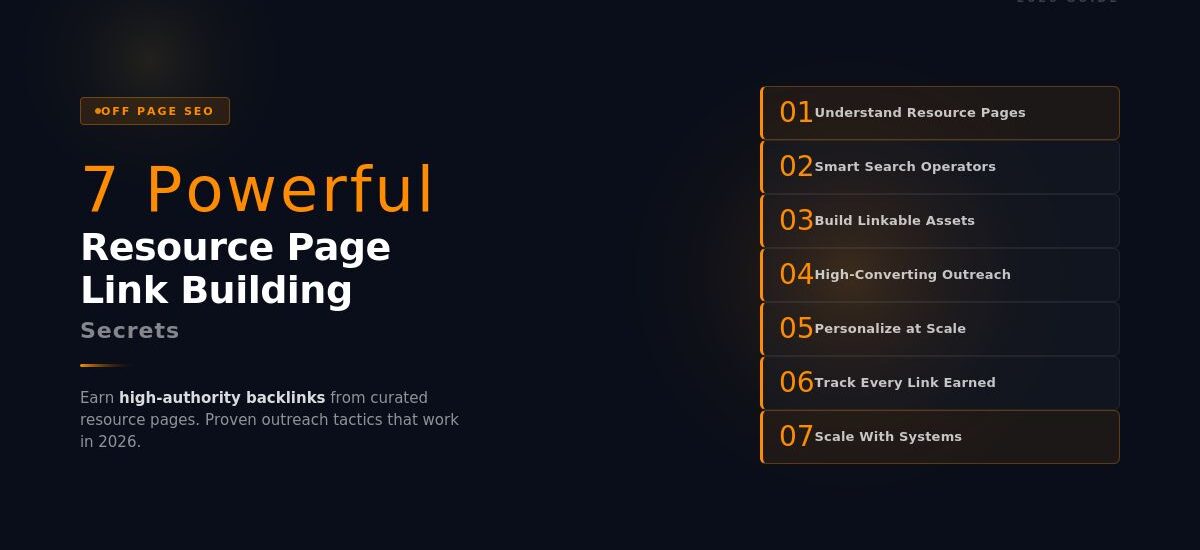
This guide gives you 7 actionable secrets that work in 2026. Each secret covers a specific part of the process, from finding the right pages to tracking the links you earn. Follow this system, and you build a backlink profile that grows your organic search rankings month after month.
Table of Contents
Secret 1: Understand What Resource Pages Actually Are
Resource page link building starts with knowing exactly what you are looking for. A resource page is a curated list of links on a specific topic. Webmasters build them to help their audience find the best content in one place. They are not blog posts or service pages. They are dedicated link collections that editors actively maintain.
What Makes a Page a True Resource Page
A genuine resource page has clear signals. The URL often contains words like /resources/, /links/, or /useful-tools/. The page title usually says something like “Best Resources for [Topic]” or “Recommended Sites.” The content is a list of outbound links with short descriptions. There are no sales pitches, ads, or filler.
Common resource page formats include:
- “Best Tools for [Topic]” pages maintained by industry blogs
- “Helpful Links” or “Further Reading” sections on authority sites
- “Top Resources for [Industry]” pages on university and nonprofit domains
- “Recommended Reading” lists on expert personal sites
- Curated resource hubs on government and .edu domains
These pages carry strong domain authority in most niches. A single link from a well-maintained resource page delivers more link equity than dozens of low-quality directory submissions.
Why Resource Page Links Carry More SEO Weight
Google treats these links as genuine endorsements. The anchor text is natural. The surrounding content is topically relevant. The page itself exists to add value, not manipulate rankings. This combination sends powerful topical authority signals to search engine crawlers.
Sites with strong resource page backlink profiles rank better for long-tail keywords and build organic search visibility faster. According to
Ahrefs’ research on link building, editorial links from curated pages consistently score higher on link quality metrics than most other acquisition methods.
According to Moz’s guide to link building, editorial links are among the most powerful ranking signals you earn. The key difference is intent. These links earn their place.
Secret 2: Master Resource Page Link Building With Smart Search Operators
Most people searching for resource pages use generic queries and get generic results. You need precise Google search operators to surface pages actively curating links in your niche. This is where resource page link building becomes a repeatable system.
Find Hidden Opportunities Using Targeted Search Strings
Use these exact search strings in Google to find resource pages in any niche:
- inurl:resources + “your keyword”
- intitle:resources + “your niche”
- “helpful links” + “your topic”
- “recommended resources” + “your industry”
- “useful links” site:.edu
- “best tools” + intitle: “resources.”
- “further reading” + “your keyword”
- “links we love” + “your niche”
Save every URL in a spreadsheet immediately. Tag each one by niche relevance, estimated domain rating, and last updated date. Do not stop at page one of Google results. Resource pages rarely invest in SEO themselves, so they often sit on page three and four.
For a complete breakdown of link-building strategies that work alongside this method, read
Best Link Building Strategies for Small Businesses in 2026 on the BacklinksHatch blog.
Qualify Each Page Before You Send a Single Email
Apply these five filters to every prospect before writing an email:
- Domain rating above 30 (use Ahrefs, Moz, or Semrush to verify)
- Last updated within 18 to 24 months (outdated pages rarely add new links)
- Relevant existing links (other links on the page match your niche)
- Under 200 outbound links (pages with too many links dilute value)
- Not a paid directory (check for “submit your site” payment pages)
Apply these filters, and your outreach list shrinks significantly. A list of 40 qualified targets outperforms a list of 400 random ones every time.
Secret 3: Create Content That Earns Its Place on Resource Pages
You cannot pitch a resource page with a thin 500-word post. You need a linkable asset. This is a piece of content so genuinely useful that a resource page editor has a clear, immediate reason to include it. The content does the heavy lifting. Your outreach email only opens the door.
Build a Linkable Asset That Editors Cannot Ignore
The best linkable assets solve a specific problem for a specific audience. They save readers time or give them something they cannot easily find elsewhere. Before you build yours, study the existing links on your target resource pages.
High-performing linkable asset formats:
- Ultimate guides with 3,000+ words and original research or data
- Free tools or calculators that solve a recurring problem in your niche
- Original data studies with statistics that other writers want to cite
- Comprehensive curated lists that save readers hours of manual research
- Step-by-step tutorials with clear visuals, screenshots, or video walkthroughs
- Glossaries and reference pages for technical or industry-specific terms
Your content must answer one question when an editor visits: “Does this genuinely help my audience?” If the answer is not obvious within the first 10 seconds, revise before you pitch.
For guidance on structuring content that ranks and earns links simultaneously, read
Keyword Research for Beginners: Step-by-Step Guide (2026) to align your content with what people actually search for.
Match Your Content Format to Each Resource Page
Every resource page has a defined purpose. A page titled “Best SEO Tools for Beginners” links to tools, not case studies. A page titled “Content Marketing Resources” links to guides and research, not product pages.
Study the existing links on each page before writing your pitch. Note the content format they favor. Note the reading level of their audience. Note whether they prefer short tools or long-form guides. Then match your pitch to what already fits their pattern.
This single adjustment raises your acceptance rate more than any other factor. You are not asking editors to change their curation standard. You are showing them that your content already meets it.
Secret 4: Write Outreach Emails That Get Real Replies
Most outreach emails fail for the same reasons. They are too long. They focus on what the sender wants rather than what the editor gains. They use obvious templates that editors recognize in the first three words.
The Anatomy of a High-Converting Pitch Email
A strong resource page outreach email has five core elements. Each element earns its place.
- Subject line: Reference their specific page title directly
- Opening sentence: Prove you visited their page. Name one specific link already on their list
- Your resource description: Two sentences maximum. What your content covers and who it helps
- Benefit to their readers: One sentence on why their audience gains value, not why you deserve the link
- Call to action: One direct question: “Would you consider adding it to your list?”
Keep the entire email under 150 words. Every word must earn its place. Editors get dozens of pitches per week.
Case Study: 23 Editorial Links in 60 Days
A project management SaaS company built a free team productivity calculator as its linkable asset. They identified 180 resource pages using the search operator method above. Their outreach email averaged 118 words. The subject line referenced each page title individually.
Results after 60 days:
- 23 confirmed resource page backlinks earned
- 34% increase in organic traffic to the calculator page
- Target keyword moved from position 18 to position 4
- Average domain rating of linking pages: 42
- Outreach conversion rate: 12.8% on qualified list
To understand how long new links take to impact rankings, read
How Long Does It Take for Backlinks to Affect Rankings? for a realistic timeline breakdown.
Secret 5: Personalize at Scale Without Sacrificing Quality
Personalization does not mean writing every email from scratch. It means adding specific details that prove you looked at the recipient’s site. You automate the structure. You personalize the proof.
Build a Simple Personalization System That Scales
Your personalization system needs four variables for each prospect. These take five minutes to research per prospect and raise reply rates from 2% to 12-15%.
The four personalization variables:
- The exact name of their resource page (copy it from the page title)
- One specific link is already on their page that you reference positively
- A one-sentence note on why your content adds to, not duplicates, that existing link
- The editor’s first name when findable via the About page or LinkedIn
Build a spreadsheet with one row per prospect and one column per variable. Use a mail merge tool to insert these variables automatically. Review 10 to 15 emails manually before deploying any batch. This system processes 50 to 80 outreach emails per week with two to three hours of work.
According to Backlinko’s outreach study, personalized outreach emails get 32.7% more replies than generic templates. Specificity is the single biggest lever you have.
Timing, Follow-Up, and When to Move On
Send your first email on Tuesday, Wednesday, or Thursday morning in the recipient’s local timezone. Wait exactly seven days before following up. Your follow-up email should be two sentences. Sentence one references your original email. Sentence two asks if they had a chance to review your resource.
Send one follow-up only. Two touches are the professional limit for unsolicited outreach. If someone does not reply after your follow-up, remove them from your active list and move to the next prospect.
Secret 6: Track and Measure Every Link You Earn
Resource page link building only compounds when you measure it. Most people build links and never analyze which ones worked. A basic tracking system from day one gives you the data to double down on what drives results.
Build a Simple Link Tracking Dashboard
Use this tracking table as the foundation of your monthly reporting:
| Metric | What to Track | Recommended Tool |
|---|---|---|
| Domain Rating | Authority score of linking domain | Ahrefs or Moz |
| Anchor Text | Exact text used to link to your page | Google Search Console |
| Referral Traffic | Visits arriving from each resource page | Google Analytics 4 |
| Keyword Movement | Authority score of the linking domain | Semrush or Ahrefs |
| Outreach Conversion | Emails sent vs links earned | Google Sheets |
| Page Indexing Status | Confirms Google indexed the linking page | Google Search |
| Link Status | Position change for the target keyword | Ahrefs Site Explorer |
Connect Links to Business Outcomes That Matter
A link only matters if it moves a metric that matters to your business. Track whether resource page links drive referral traffic that converts. Check if linked pages show improved crawl frequency in Google Search Console. Monitor whether your domain rating increases month over month.
According to Google’s Search Central documentation on links, crawlable and contextual links pass the most value. Making sure your site is technically healthy ensures these links get properly counted.
For a deeper understanding of how your technical setup affects whether links get properly crawled and counted, read
How to Fix Website Crawl Errors and Get Indexed Faster.
Secret 7: Scale Your Outreach With Repeatable Monthly Systems
Resource page link building produces the best results as a consistent monthly process, not a one-time campaign. The value compounds. After six months, you have a growing backlink profile. After twelve months, the cumulative SEO impact becomes substantial.
Build a Repeatable Monthly Process
Week 1: Prospect Research. Use your search operator strings to find 60 to 100 new resource page URLs. Run each through your five-point quality filter. Add qualified prospects to your outreach spreadsheet with all personalization variables filled in.
Week 2: Content Audit. Review your linkable assets. Confirm they are still the strongest option for your current prospect batch. Update outdated statistics or examples if needed.
Week 3: Outreach Execution. Write and send personalized outreach emails to your qualified list. Send in batches of 15 to 20 per day to avoid deliverability issues. Track open rates and adjust subject lines that underperform.
Week 4: Follow-Ups and Reporting. Send follow-up emails to non-responders from Week 3. Log all positive responses and confirmed links. Update your tracking dashboard. Note which personalization angles produced the most replies.
When to Keep It In-House Versus When to Delegate
Keep strategy decisions in-house. Deciding which resource pages to target, which content to pitch, and how to position your asset requires deep niche knowledge.
Delegate operational work once your process is fully documented. A trained virtual assistant handles prospect research, spreadsheet management, and follow-up emails effectively once they understand your quality standards.
Understanding the difference between ethical and risky practices protects your site as you scale. Read
White Hat vs Black Hat Link Building: What’s the Difference in 2026? before expanding your outreach volume significantly.
For additional context on how link building fits into a broader SEO strategy, see Semrush’s complete link building guide, which covers advanced prospecting methods beyond resource pages.
Frequently Asked Questions
What is resource page link building?
It is the process of earning backlinks by getting your content listed on curated resource pages. These are pages that editors build specifically to link out to the best content in their niche. The links are editorial and free. You earn them by creating content worth recommending and pitching the right editors.
How is this different from directory submission?
Directories accept almost any site, often for a fee. Resource pages are curated. Editors choose what to include based on quality. This editorial selection is exactly why resource page links carry more weight with Google than directory links.
How long does it take to see ranking results?
Most campaigns show measurable keyword movement within 60 to 90 days of earning the first links. Traffic impact varies depending on the domain authority of the linking pages and how competitive your target keywords are.
Do I need a big budget to run this strategy?
No. The main investment is time. You need a quality piece of content, a backlink analysis tool subscription (Ahrefs starts around $99 per month), and an email account. Many effective campaigns run on under $150 per month in tool costs.
How many outreach emails should I send per month?
Start with 30 to 50 personalized emails per month. A 12 to 15% reply rate on 50 quality emails beats a 2% reply rate on 500 generic ones every time. Build volume only after you confirm your process converts.
What content type earns the most resource page links?
Free tools and calculators earn the highest acceptance rates because they add functional value. Original data studies come second because they give editors something citable. Long-form ultimate guides perform well in education and marketing niches specifically.
Is this strategy safe for SEO in 2026?
Yes. Resource page links are editorial by nature and align fully with Google’s link quality guidelines. This is one of the safest off-page SEO strategies available. According to Google’s guidelines on link spam, editorial links freely given based on content merit are exactly what Google rewards.
Conclusion
Resource page link building delivers editorial backlinks from sites built to share great content. The strategy works because the intent is genuine on both sides. You create something worth recommending. The editor recommends it. Google counts it.
The seven secrets in this article give you a complete system. Start with one strong linkable asset. Run your first batch of 40 qualified outreach emails. Track every reply and every link earned. Measure the impact after 60 days. Then scale what works.